There’s a particular kind of grief that only anime fans know. You invest months — sometimes years — into a series. You learn the characters like they’re old friends. You feel the weight of every arc, every sacrifice, every payoff that’s been building since episode one. And then it stops. Not because the story ended. Because the adaptation did.
We’ve all been there. Watching the credits roll on a finale that wasn’t really a finale. Knowing the manga is still going, or worse — already finished — while the anime just left you standing in the wreckage of an incomplete story. It’s a specific, maddening kind of abandonment.
But something shifted. Quietly at first, then all at once. The studios started coming back. Not just with sequels or spinoffs, but with completions. With endings. With the deliberate, considered act of finishing what they started. And as we move through 2026, it’s become impossible to ignore: we are living through an era of return, and it feels meaningfully different from anything that came before it.
This isn’t coincidence. It’s not nostalgia bait dressed up as fan service. There’s something structural happening in how anime is being made, financed, and consumed — and understanding it changes how you watch everything that’s come back.
The Returns That Redefined Expectations
Let’s start with the one that broke the dam: Bleach.

When Bleach’s original anime run ended in March 2012, it wasn’t exactly a dignified farewell. The series had been plagued by filler — some of the most egregious padding in shonen history — and the adaptation concluded mid-story, leaving the Thousand-Year Blood War arc completely untouched. For a decade, it existed in this strange limbo: one of the most beloved Big Three series, but one that anime-only fans had never seen finished.
Then Tite Kubo came back. Not just to finish the manga — he’d already done that — but to oversee an adaptation that would finally do the arc justice. When Bleach: Thousand-Year Blood War premiered in October 2022, the production quality was staggering. Studio Pierrot brought a visual ambition to the series that the original run, constrained by weekly schedules and budget realities, simply couldn’t have delivered. The fights weren’t just good — they were revelatory. Yhwach’s invasions felt catastrophic. The Sternritter each got moments that manga readers had imagined for years, now rendered with fluid animation that elevated the source material.
The response wasn’t just enthusiasm. It was relief. Collective, decade-long relief.
Bleach TYBW’s final arc carries the weight of that entire return with it. Every frame is doing double duty — telling the story and honoring the wait. That’s a different kind of pressure than any seasonal premiere faces, and the fact that it’s handled that pressure this well tells you something important about what’s changed.
One Piece is a different case entirely — it never went away. But the Elbaf Arc represents something categorically new for the series: the beginning of the end. Oda has been building toward this for literally decades. The lore threads that stretch back to Little Garden, the implications that ripple forward to Laugh Tale — Elbaf is where the final saga starts cashing checks that were written in the late ’90s. Watching it animated, knowing that the conclusion is no longer hypothetical but actively in motion, shifts the emotional register of every episode. The Elbaf arc isn’t just a great story beat. It’s a marker. It means we’re actually getting there.
Dr. Stone and the Art of the Finale
Dr. Stone deserves its own conversation because its return operates on a different frequency than Bleach or One Piece. This isn’t about completing an arc or entering a final saga. This is about ending a series with full creative control, full awareness of what you’re doing, and the specific gravity that comes from knowing the finish line is right there.
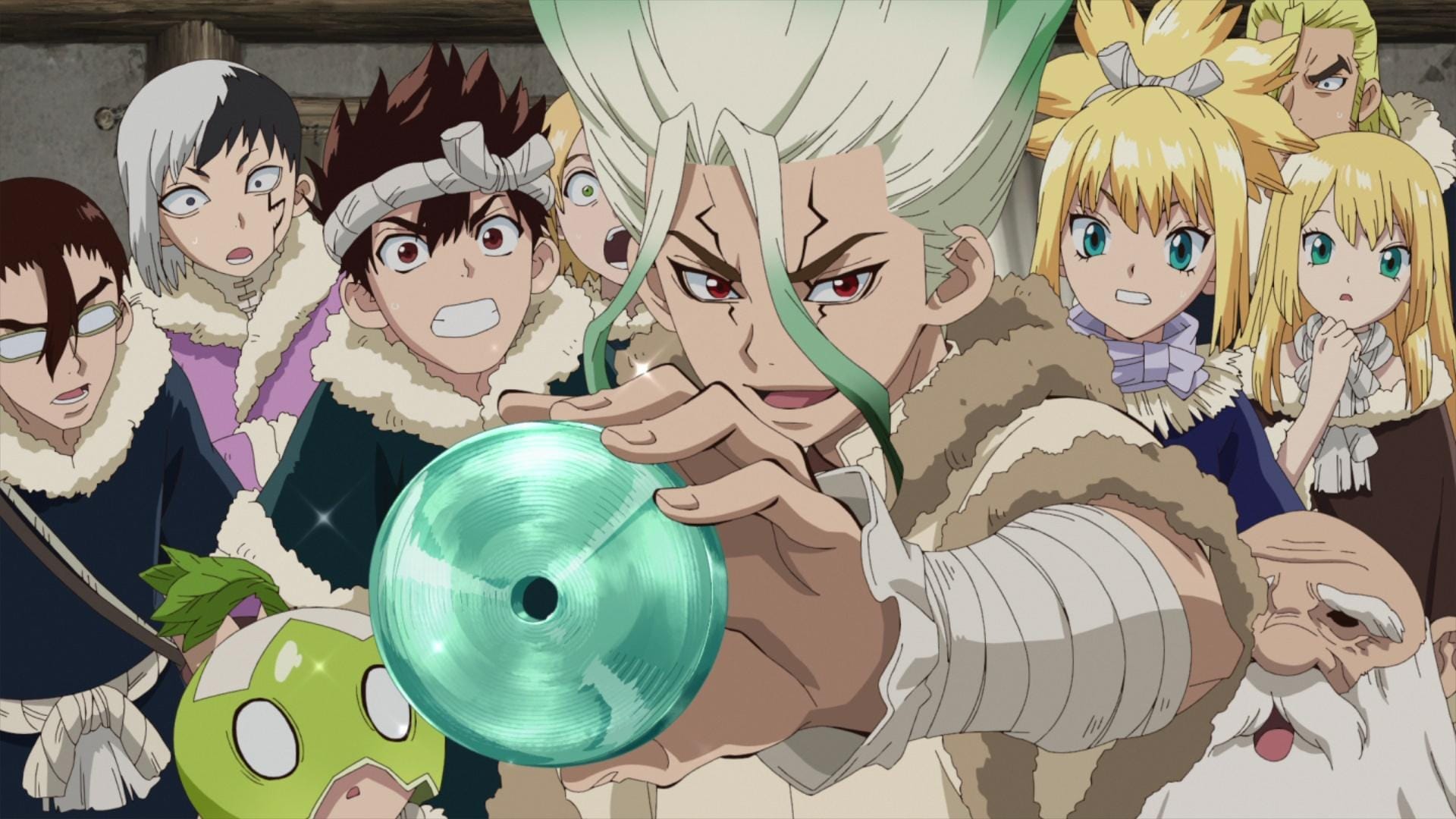
The Dr. Stone legacy was already secure before Season 4. The series accomplished something genuinely rare: it made science not just accessible but thrilling. Senku’s brain felt like a legitimate superpower. The stone-by-stone reconstruction of civilization carried actual educational weight without ever becoming a lecture. And Boichi’s art elevated every invention reveal into something that felt like a genuine miracle.
But finales are a specific craft. Not every series that gets to end cleanly actually sticks the landing. The pressure of conclusion — the need to honor every thread, every character, every thematic promise made over years of storytelling — is immense. What makes Dr. Stone’s final run remarkable is how unsentimental it is about that pressure. It trusts the audience. It trusts the science. It trusts Senku.
There’s a lesson in that for the industry. When you give a series room to breathe, when you let it build toward a real ending rather than just continue indefinitely, the conclusion carries genuine emotional weight. You can’t manufacture that. It comes from the accumulated investment of everyone who stayed the whole way through.
Re:Zero and the Long Game of Trust
Re:Zero’s revival is fascinating for different reasons. The series has always been structurally unusual — the Return by Death mechanic means it operates on a fundamentally different timeline logic than most isekai. Subaru doesn’t progress linearly. He loops, he fails catastrophically, he rebuilds. The emotional toll of watching that unfold over multiple seasons creates a bond between audience and character that’s almost adversarial in its intensity. You root for Subaru partly because you’ve watched him broken apart and reassembled so many times.
After Season 2’s long, brutal arc — which genuinely felt like watching someone get destroyed slowly from the inside — the return in 2026 arrives with the weight of everything that happened before it. The audience hasn’t forgotten. Re:Zero fans have the kind of memory that comes from emotional trauma, the good kind. Every detail sticks because the series made you feel the stakes.
What the revival proves is that trust, once built, holds. The gap between seasons didn’t erode the fanbase. If anything, the wait filtered for the most committed viewers — the ones who are showing up not just because it’s new and shiny, but because they have unfinished business with this story. That’s a different audience than a seasonal premiere captures. It’s harder to earn and far more durable.
Why Studios Are Betting on Nostalgia (And Why It’s Smarter Than It Looks)
There’s an easy cynical read on all of this. Studios are mining IP nostalgia because it’s lower risk than developing original properties. Legacy titles come with pre-built audiences, proven merchandise markets, and franchise recognition that lowers the activation energy for new viewers. From a pure business standpoint, completing Bleach is a safer bet than launching something nobody’s heard of.
That read isn’t wrong. But it’s incomplete.
The fuller picture requires understanding how the streaming era changed the economics of anime production. When Crunchyroll, Netflix, and other platforms became major financing sources, they brought with them a different set of incentives than traditional broadcast television. Streaming platforms care about catalog depth and completion. A series that ends — that has a definitive, satisfying conclusion — becomes a different kind of asset than one that just keeps going. It can be marketed as a complete experience. It can bring in new subscribers who want to binge the whole thing from start to finish.
That’s a structural incentive to actually finish things. And it aligns, almost accidentally, with what fans have been asking for since the era of eternal-filler shonen began.
According to data from Anime News Network‘s industry coverage, Blu-ray and streaming numbers for legacy title revivals have consistently outperformed projections. Bleach TYBW broke viewership records on multiple platforms. The audience for completed or completing series isn’t just the holdovers from the original run — it’s the people who heard that a legendary series was finally getting finished and decided to start from the beginning. That’s a compounding effect that seasonal one-off titles almost never get.
The Seasonal Model vs. The Long Game
It’s worth being honest about the tension here, because not everything about this era of returns is uncomplicated.

The seasonal model has produced extraordinary anime. The constraint of 12-13 episodes forces a discipline that long-running series often lack. You can’t pad when you only have 12 episodes. Every scene has to earn its place. Some of the most respected anime of the past decade — Vinland Saga, Frieren, Chainsaw Man, Attack on Titan — operate in seasonal formats and benefit enormously from that compression.
But there’s something the seasonal model can’t fully replicate: the experience of growing up with a story. Of watching characters age and change and suffer across years of your own life, so that their journey becomes entangled with yours. That’s what long-running anime does when it’s working. You don’t just watch Luffy — you watch him across arcs that span different chapters of your own life, and the emotional resonance compounds in ways that no single-cour series can match.
The return of long-running anime in 2026 isn’t an argument that the seasonal model is wrong. It’s an argument that both can coexist, and that each serves a different emotional need. What’s new is that the industry is finally recognizing that the completion of long-form stories is itself a product worth investing in. Not just the ongoing serialization — the ending.
For a breakdown of everything airing this season alongside these returning titans, the Spring 2026 anime season guide has the full picture of how the schedule is looking.
What It Actually Means for Fans
Here’s the part that doesn’t get said enough: what’s happening right now is historically unusual, and we should probably appreciate it in real time rather than only in retrospect.
For most of anime history, the deal was implicit and often cruel: studios would adapt as much as was commercially viable, then stop. The manga would continue. The story would conclude somewhere inaccessible to anime-only fans unless they made the jump to reading. Long-running series either ran forever with diminishing quality, got canceled mid-arc, or limped to a filler-padded conclusion that satisfied nobody.
What we’re seeing now — Bleach concluding with cinematic production quality, One Piece committing to the final saga, Dr. Stone getting a proper ending, Re:Zero continuing to completion — is a different contract. Studios are committing, publicly and financially, to finishing what they started. That’s not the default mode of this industry. It’s a choice, made possible by a specific confluence of economic incentives and fan appetite, that may not persist forever.
There’s also something worth acknowledging about the emotional weight these completions carry for fans who’ve been waiting. When Bleach TYBW shows you Ichigo’s bankai rendered with modern animation technology, you’re not just watching a cool fight. You’re watching a promise kept. A twelve-year-old promise, made by an adaptation to its audience, finally honored. The feeling of that is distinct from almost anything else in entertainment — this specific mix of vindication, nostalgia, and genuine artistic appreciation for something being done right.
It’s okay to feel that. It’s one of the things anime does better than most other mediums.
The Studios That Made This Possible
None of this happened by accident. The specific choices studios made in adapting these returns deserve recognition because they set a standard that the industry will be measured against going forward.
Studio Pierrot’s work on TYBW represented a genuine artistic reckoning with the source material. Kubo’s involvement — his direct oversight of scene selection, color direction, and the additions that never made it into the manga — turned the adaptation into something that’s simultaneously faithful and expansive. The fight choreography in TYBW doesn’t just animate the manga panels; it extrapolates from them, finding movement and weight that printed pages can’t convey.
Toei’s handling of One Piece in the Elbaf era reflects years of internal conversation about production quality. The series has always had a complicated relationship with its own pacing — the notorious stretching of scenes that turns Oda’s dense chapters into episodes that feel drawn-out. But as the series enters its endgame, there’s a visible intentionality to how the adaptation is being handled. This isn’t going to get the gag treatment. These final arcs are being protected.
TMS Entertainment’s production on Dr. Stone has leaned into the series’ unique visual identity. The science sequences — the ones that actually show you the chemistry and physics underlying Senku’s inventions — maintain the educational rigor that made the series valuable, even as the plot operates at a pace that signals genuine finality. They know what they have. They’re not wasting it.
A Different Kind of Anime Calendar
If you step back and look at what the 2026 anime calendar actually contains, it’s kind of staggering. We have multiple generations of long-running series all in various stages of completion simultaneously. New seasonal hits coexist with the conclusions of stories that started before some current seasonal anime fans were in high school.
This creates an unusual viewing experience. You can, in a single week, watch an episode of a series you’ve followed for a decade and an episode of a series you started three weeks ago. Both might be excellent. Both might be emotionally affecting. But they’re affecting you differently, and the distinction matters.
The long-running returns carry a specific gravity — a weight that comes from accumulated time and trust and loss and relief. The seasonal premieres carry a different kind of energy — possibility, discovery, the excitement of not yet knowing where something is going. Both are worth experiencing. And the fact that 2026 offers both in such abundance, at such a level of quality, makes it one of the most interesting years to be an anime fan in recent memory.
We’ve spent years talking about the golden age of anime like it’s a question of when and whether it’s happening. Maybe instead of asking whether we’re in a golden age, we should just pay attention to what’s in front of us: the returns, the conclusions, the promises being kept, the stories being finished. That’s the thing that matters. The rest is just counting.
Long running anime returning in 2026 isn’t a marketing moment. It’s a reckoning with what this medium is capable of when it commits to finishing what it starts — and a reminder that some stories are worth waiting for.