What Even Is Kuroko’s Basketball? The Premise You Need to Know
If you’re searching for a Kuroko’s Basketball review because someone told you it’s “just a sports anime,” let me stop you right there — this show is so much more than that. Kuroko’s Basketball (Kuroko no Basuke) is a basketball anime that throws realism straight into the trash, replaces it with anime superpowers barely disguised as athletic skills, and dares you not to lose your mind screaming at your screen. It’s one of the most purely entertaining sports anime ever made, and if you haven’t watched it yet, this review is your official permission slip to start immediately.

The story kicks off at Seirin High School, a brand-new basketball team with zero legacy and zero fear. Their secret weapon is Kuroko Tetsuya, a ghost of a player — literally so forgettable that opponents lose sight of him mid-play. He was the phantom sixth man of Teiko Middle School’s legendary squad: the Generation of Miracles, five prodigies so obscenely talented they basically broke competitive basketball just by existing. Now scattered across rival high schools, each one is a walking final boss. Seirin’s other key player is Kagami Taiga, a massive, explosive power forward who learned his game in America and has the raw talent to challenge anyone. Together, they’re on a mission to beat every single member of the Generation of Miracles — which sounds insane, because it absolutely is.
The Generation of Miracles isn’t just a cool name. Each member has a specific basketball “skill” that functions as a full-on superpower. We’re talking about players who can copy any move after seeing it once, a shooter who enters a trance state that makes him physically incapable of missing, and a point guard who can see the entire court and predict every movement five seconds into the future. This is the world Seirin has to survive. And somehow, episode after episode, the show makes you believe they can do it.
It’s a Battle Shonen. The Sport Is Just the Setting.
Let’s be honest about what Kuroko’s Basketball actually is: it’s Dragon Ball Z with a basketball. It’s Naruto on hardwood. The show wears the costume of a sports anime but it has the beating heart of a battle shonen, and once you accept that, everything clicks into perfect, glorious place.

Think about the classic shonen formula: a hero who lacks raw power but has an extraordinary hidden ability, a rival who starts as an enemy but becomes an ally, escalating tournaments with increasingly unbeatable opponents, power-ups that arrive at the last possible moment, and an underlying theme about what true strength really means. Kuroko’s Basketball hits every single one of those beats, just with free throws instead of Kamehamehas. The “Zone” — this show’s version of going Super Saiyan — is a perfect example. When a player enters the Zone, they achieve a state of perfect focus where their physical abilities are essentially maximized beyond normal human limits. It sounds vaguely sporty until you see it animated, at which point it looks exactly like someone unlocking a new power level mid-fight.
The tournament structure feels lifted directly from Chunin Exams or the Dark Tournament. Seirin grinds through qualifiers, faces meaningful setbacks that force character growth, and builds toward inevitable showdowns with the Generation of Miracles one by one. Each matchup is essentially a boss fight. The pacing, the dramatic music drops, the close-up reaction shots, the speeches about willpower and bonds and not giving up — this is shonen storytelling at its most shameless and its most effective. The basketball is the canvas. The genre is pure shonen.
This isn’t a criticism. It’s a celebration. Kuroko’s Basketball leans into its own absurdity with complete confidence, and that confidence is contagious. You don’t watch this show despite the ridiculousness — you watch it because of it. Every game feels like a war, every point feels earned, and every comeback hits harder than any realistic sports drama could manage.
The Superpowers (Seriously, These Are Just Superpowers)
Let’s run the full breakdown, because the Generation of Miracles’ abilities deserve their own dedicated appreciation. These are officially described as basketball skills in the show. They are, functionally, magic.

Kuroko Tetsuya — Misdirection and Phantom Passes: Kuroko’s “lack of presence” is so pronounced that people’s eyes naturally slide right off him, even in a crowd. He exploits this by threading passes through seemingly impossible angles because defenders literally cannot track someone they’ve stopped consciously registering. By the end of the series this evolves into a direct pass variant that carries such unexpected force and trajectory that even talented players can’t react to it. That’s not a skill. That’s an invisibility power with basketball mechanics bolted on.
Kise Ryota — Perfect Copy: After seeing any move once, Kise can replicate it with the same or better execution. This extends to copying the abilities of the other Generation of Miracles members themselves, which should be physically impossible and the show fully acknowledges it is. His “Perfect Copy” state is basically him going Super Saiyan 2.
Midorima Shintaro — 100% Shooting Accuracy: From anywhere on the court. Full court shots. Around defenders. Eyes closed. He carries good-luck charms selected by his horoscope every day, and this matters because the show treats his shooting as a kind of ritualistic certainty. The ball doesn’t so much travel an arc as it traces a perfect mathematical destiny to the basket.
Aomine Daiki — Formless Shot: Aomine can shoot from any position, any angle, any body orientation — mid-fall, off-balance, essentially upside-down. His shot has no defined form, which means conventional defensive positioning is useless against him. He’s physically the most dominant player in the series and the first true wall Seirin hits that feels genuinely unclimbable. His arc is also one of the best in the show.
Murasakibara Atsushi — Total Domination: Seven feet tall, enormous wingspan, capable of crushing basketballs with his grip strength, and with reflexes fast enough to swat shots that most players couldn’t physically reach. He’s the immovable object of the series, and his battles with Kagami are pure collision-of-forces chaos.
Akashi Seijuro — Emperor Eye: The captain. The final boss. Akashi can see the micro-movements of an opponent’s body and predict their actions before they happen. He can also use this to force opponents off-balance with surgical ankle-breaking crossovers. In his fully unleashed state his eye turns a different color, he moves with preternatural calm, and he has never lost at anything in his life. The show treats this as a personality fact, not just an athletic one. He has literally never lost a game of any kind. He is functionally a god wearing a basketball jersey.
And then there’s the Zone — accessible not just to Kagami but eventually to other players as well. The Zone is the show’s trump card, deployed sparingly in the highest-stakes moments. When a player enters the Zone, time seems to slow, their body moves at a level beyond their conscious control, and the game transforms into something beyond sport. There’s even a “direct drive zone” that requires teammates to enter synchronized flow states together. By this point the show has fully ascended into a different category of storytelling and it is magnificent.
The Matches That Will Destroy You Emotionally
Kuroko’s Basketball has some of the best individual game sequences in all of sports anime. Across three seasons and the sequel film “Last Game,” the series delivers match after match that escalates beyond anything you thought it could reach. Here are the ones that hit hardest.

Seirin vs. Tōō Academy (Aomine): The first true gut-punch. This is where the show establishes that the gap between Seirin and the Generation of Miracles isn’t just talent — it’s a different category of existence. Aomine is so far ahead of everyone that he doesn’t even try during the first quarter, and he’s still winning. Watching Kuroko and Kagami hit their personal ceiling and still fall short is genuinely heartbreaking. This loss hurts in a way that makes everything that follows feel earned.
Seirin vs. Shūtoku (Midorima, Round 2): Midorima is technically impossible to beat if he’s hot from anywhere on the court. The game mechanics the show invents to create a plausible path to victory here are creative enough to feel satisfying rather than cheap. Kagami’s confrontation with Midorima is also one of the purest “clash of styles” matchups in the series.
Seirin vs. Kaijō (Kise): Kise is possibly the most charismatic member of the Generation of Miracles, and his games against Seirin — there are multiple — are consistently spectacular. His Perfect Copy mode in the final matchup is the show operating at peak theatrical energy. Watching Kuroko figure out how to counter someone who can copy Kuroko is a great piece of sports anime writing.
Seirin vs. Rakuzan (Akashi): The finale. The whole show builds to this. Akashi as a final opponent is terrifying because the show has spent so much time establishing that he doesn’t lose — not through narrative contrivance but through the genuine fear that permeates every character’s reaction to him. This match goes places. Multiple power escalations, emotional revelations about Akashi’s past, Kuroko doing something so fundamentally extra that you might need to pause and collect yourself. It earns everything it spends.
Kuroko and Kagami: The Partnership That Runs the Show
At the center of all the superpowers and tournament drama is something surprisingly genuine: the friendship between Kuroko and Kagami. Their dynamic is the emotional engine that makes the absurdity land.
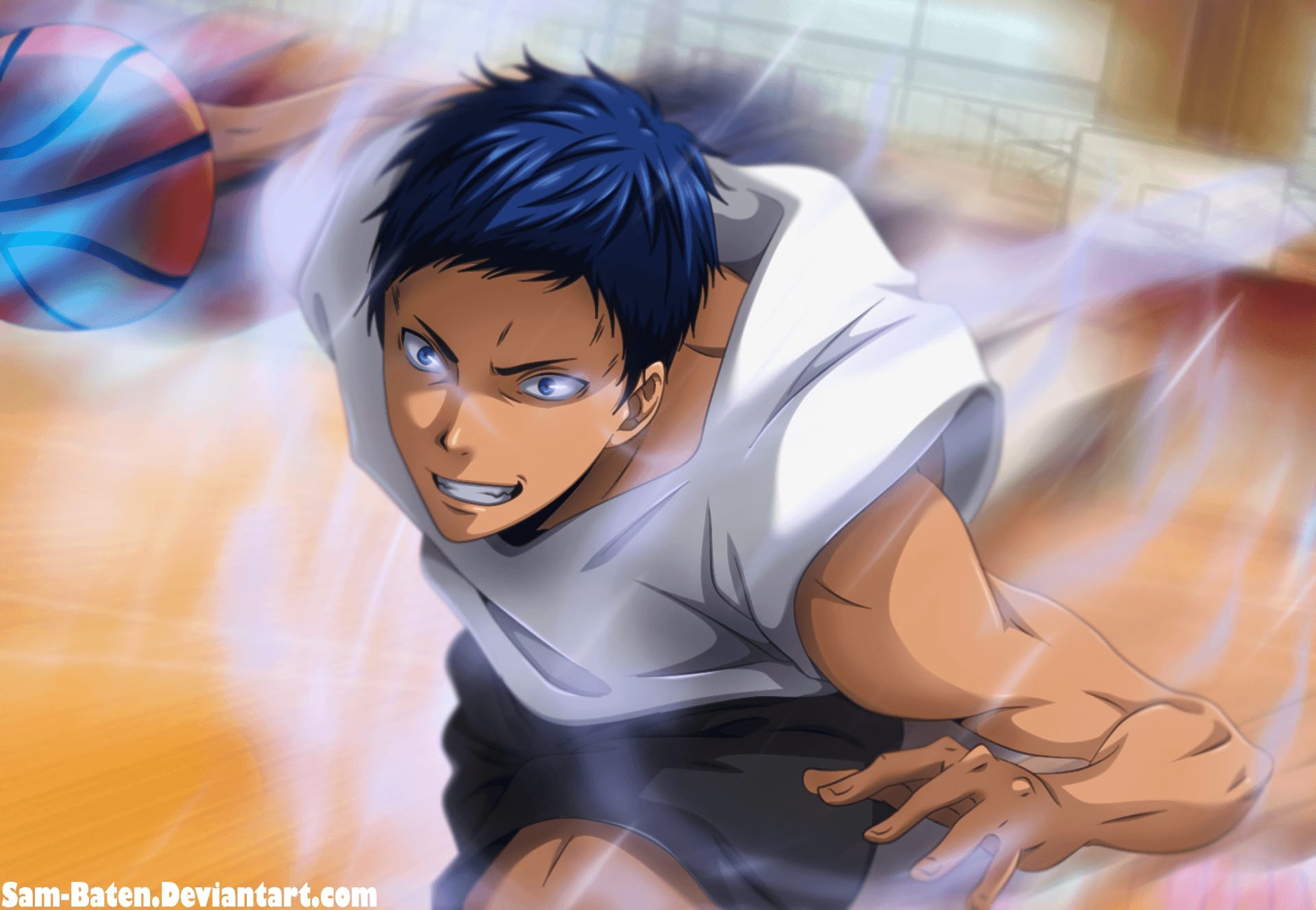
Kagami is all fire and instinct — a player who runs on competition and pure physical drive, who genuinely loves basketball in the way that makes him want to beat the best at it. He’s loud, reactive, and enormous. Kuroko is the opposite in almost every way: quiet, invisible in literal and emotional terms, someone who defines himself through supporting others rather than individual brilliance. Kuroko’s entire philosophy is that he doesn’t need his own light — he amplifies the light of his teammates. That sounds poetic until you realize the show never lets it stay poetic. It tests that philosophy repeatedly, and so does Kagami.
The tension between them is interesting because they’re not rivals — they’re partners who sometimes can’t figure out how to carry each other. Kagami pushes Kuroko to want to win for himself. Kuroko pushes Kagami to be something more than a lone powerhouse. Their victories feel shared in a way that’s different from the typical shonen protagonist dynamic, because neither of them works without the other. That’s stated explicitly in the show, but more importantly, it’s demonstrated in every major game.
The supporting cast at Seirin amplifies this partnership well. Coach Aida Riko is entertaining and competent. Hyuga as captain provides solid veteran energy. Even the bench players get moments. Seirin works as a team in a way that makes Kuroko and Kagami’s connection feel less like a duo gimmick and more like the natural focal point of a genuine squad effort.
Kuroko vs. Haikyuu: The Great Sports Anime Debate
Any honest Kuroko’s Basketball review has to address the comparison that every sports anime fan eventually makes: Kuroko’s Basketball versus Haikyuu. They represent genuinely different philosophies about what a sports anime can be, and both are excellent for almost opposite reasons.
Haikyuu is grounded. The volleyball is real volleyball. The improvement is technical. The drama comes from human psychology — anxiety, communication, reading opponents, the fear of failure under pressure. It’s a show about sports. The emotion hits because it feels true.
Kuroko’s Basketball is not grounded. The basketball is a metaphor. The drama comes from power escalation and superpower clashes. It’s a show about shonen values using basketball as its genre costume. The emotion hits because it’s operatic and committed and refuses to be subtle about anything it’s doing.
Haikyuu will probably make you cry more. Kuroko’s Basketball will probably make you stand up and yell at your TV more. Haikyuu is the better crafted show by most conventional measures. Kuroko’s Basketball is more relentlessly entertaining in the moment. This isn’t a competition with a winner — they’re satisfying different itches. The question isn’t which is better; it’s which you need right now. If you want to feel athletic tension and human drama, watch Haikyuu. If you want to watch someone shoot a basketball from the other side of the court and have it go in as destiny, watch Kuroko’s Basketball.
What Kuroko does better than Haikyuu is villain energy. The Generation of Miracles are more individually memorable as antagonists than most of Haikyuu’s rival teams. Aomine’s arc specifically — a prodigy so good that he lost the love of the game entirely until someone strong enough forced it back — is genuinely moving in a way that’s easy to miss because it’s wrapped in so much spectacle.
The Verdict: Should You Watch Kuroko’s Basketball?
Yes. Immediately. Without hesitation.
This Kuroko’s Basketball review comes down to a single honest recommendation: if you love anime and you haven’t watched this yet, you’re leaving pure entertainment on the table. It’s not the most sophisticated sports anime ever made. It doesn’t pretend to be. What it is, is one of the most purely fun things in the genre — a show that picks a lane (shonen tournament arc with basketball flavor) and executes it with total commitment and enormous style.
The animation, particularly in the climactic games, is exceptional. Studio Production I.G. handles the kinetic chaos of basketball with real craft. The moments where a pass connects just right, or a player explodes past a defender, or a shot drops through the net in slow motion — they feel designed to give you a physical reaction, and they succeed.
The soundtrack deserves special mention. The opening themes are bangers. The in-game music knows exactly when to drop and exactly how hard. Sports anime lives or dies on whether the music makes you feel the stakes, and Kuroko’s Basketball consistently delivers.
Three seasons plus an OVA series and a theatrical finale film (“Last Game” — watch it after the main series, it’s a proper victory lap). The runtime is substantial but never padded — every arc has a purpose and the pacing rarely drags. The show does get progressively more ridiculous as it goes, with power levels escalating in ways that require a certain surrender of critical judgment. Make the surrender. It’s worth it.
Kuroko’s Basketball is the basketball anime for people who love anime more than they love basketball. It’s the sports anime that made Generation of Miracles a phrase that means something. It’s the show that proves you can make someone feel genuine emotional investment in a fictional high school basketball game if you commit hard enough to the fiction. Commit to watching it. You won’t regret it.
You Might Also Enjoy
- Haikyuu Review: The Sports Anime That Actually Makes You Feel the Sport
- Slam Dunk Review: The Classic Basketball Anime That Started It All
- Hajime no Ippo Review: Boxing Anime at Its Most Relentless
- Blue Lock Review: Soccer, Ego, and Absolute Chaos
- Yowamushi Pedal Review: How Cycling Became the Most Dramatic Sport in Anime