If you’ve spent any real time with Steins;Gate, you already know that an Okabe Rintaro character analysis is no small undertaking. He’s the kind of protagonist who rewards multiple rewatches — the kind where you catch a flicker of genuine grief behind a theatrical villain monologue and realize the show was hiding it in plain sight from the very beginning. Most anime protagonists are defined by their goals. Okabe is defined by the gap between who he performs and who he actually is. That tension is the engine of Steins;Gate, and it makes him one of the most compelling characters in the medium’s history.
This isn’t a simple case of a well-designed hero with a tragic backstory bolted on. Okabe’s identity, his trauma, his relationships, and his psychological unraveling are all woven together so tightly that pulling on any one thread changes how you read the others. Let’s break down exactly why this Steins;Gate protagonist deserves to be in the conversation for the best-written character in anime.
The Mad Scientist Persona: Performance as Survival
Okabe Rintaro is eighteen years old when we first meet him, and he is already deeply committed to a bit. He calls himself Hououin Kyouma, self-proclaimed mad scientist and enemy of the shadowy “Organization.” He delivers dramatic monologues to no one. He cackles into a phone that isn’t even connected to anyone on the other end. He refers to his cramped Akihabara lab as the “Labmem” headquarters and treats microwave experiments as if they’re existential threats to the world order.
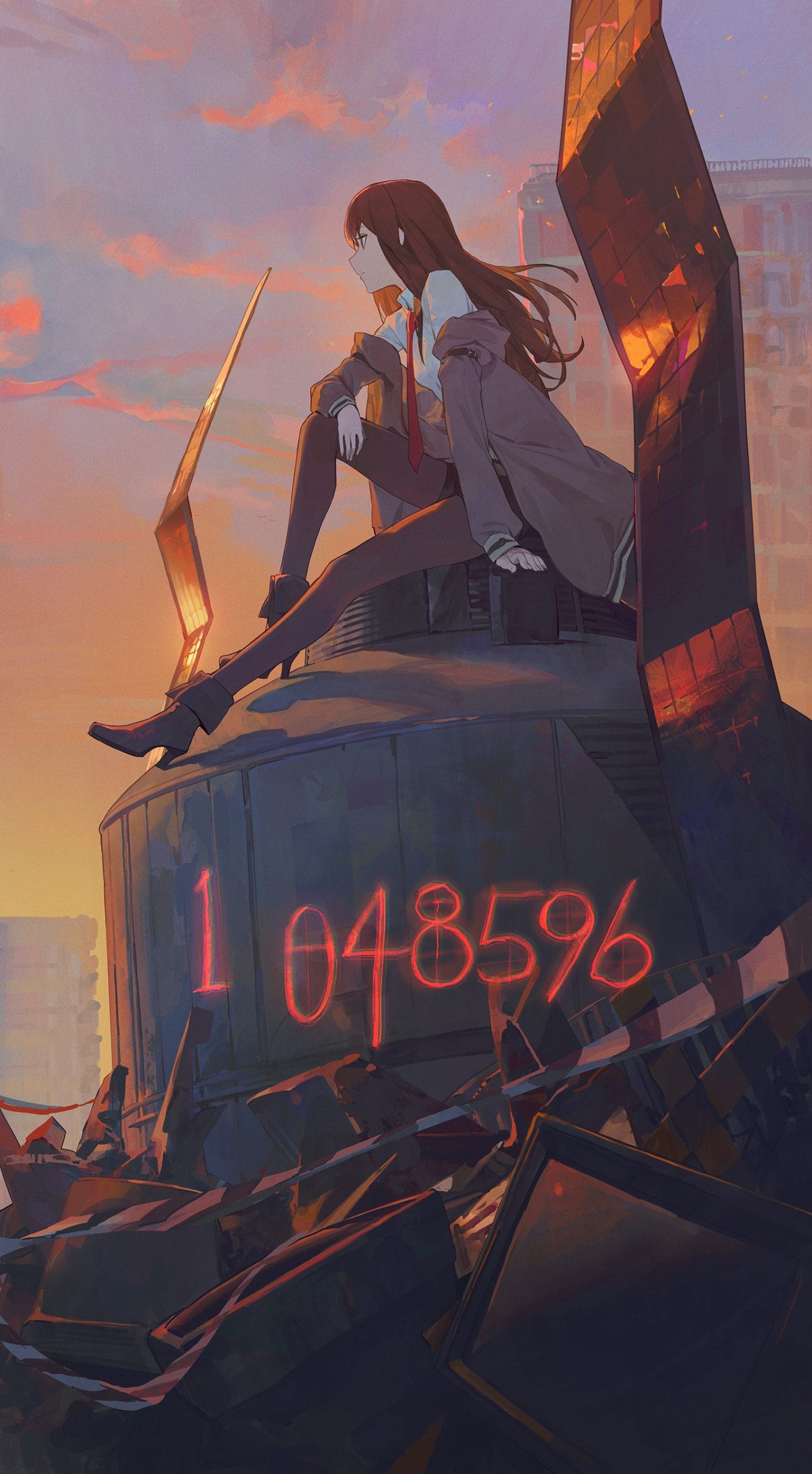
On the surface, this reads as classic comedy anime character design — the eccentric, over-the-top weirdo whose theatrics provide contrast against more grounded characters. And it does work as comedy. The bit lands, especially in the early episodes, and it’s one of the reasons Steins;Gate’s first half is so enjoyable even before the story shifts gears. But the genius is that the writing is also doing something else the entire time.
The Hououin Kyouma persona isn’t just a running joke. It’s a defensive structure. Okabe built this character for himself during middle school, almost certainly as a response to social anxiety and a deep fear of how ordinary life feels when you’re someone who thinks and feels things too intensely. By treating reality as a stage and himself as the lead villain, he gives everything weight and drama and meaning. He makes the mundane feel significant. He creates a world where he has a role — a big, important, ridiculous role — because the alternative is being a weird, isolated kid with no particular place in the social order.
This is something the mad scientist anime archetype usually misses. Characters like this are often played purely for laughs or treated as quirky decoration. Steins;Gate takes the archetype seriously enough to ask why someone would build themselves this way — and the answer it arrives at is surprisingly human.
Comedy as Cover: The Hidden Weight Beneath the Laughs
Steins;Gate’s first twelve or so episodes are frequently funny. Okabe’s interactions with Daru, his long-suffering lab assistant, are reliably entertaining. His exasperated dynamic with Kurisu — who he insists on calling “Christina” despite her objections — has genuine comedic chemistry. The whole setup of a group of nerds accidentally inventing time travel via a modified microwave is played with a light, almost slice-of-life warmth.

Then episode twelve happens, and everything the comedy was quietly covering falls into view at once.
The show doesn’t just use humor to make you like these characters before pulling the rug out — though it does do that. It uses Okabe’s comedic persona specifically to hide how much emotional labor he’s already been doing. The phone calls to nobody? It comes out that Okabe started doing this in middle school to protect Mayuri when she was grieving her grandmother. He invented Hououin Kyouma partly as a way to tell Mayuri a story — to be her “mad scientist hostage-taker” so she wouldn’t drift into the numbness of depression. He made himself into a character to keep someone he loved grounded in the world.
That reframe transforms everything retroactively. What looked like self-indulgent eccentricity becomes an act of sustained love and self-sacrifice. Okabe has been performing for so long, and for such earnest reasons, that the performance has become inseparable from who he is. He doesn’t know how to drop it anymore. And more crucially — when the stakes turn real and he finds himself unable to protect Mayuri no matter what he does — the persona cracks, and what’s underneath is devastating.
This is why the shift in episode twelve hits as hard as it does. You haven’t just lost the comedy. You’ve lost the scaffolding that was holding Okabe together, and now you have to watch him try to function without it.
Time Loop Trauma and the Weight of Being the Only One Who Remembers
The second half of Steins;Gate is one of the more psychologically brutal things in anime — not because of graphic content, but because of what it does to its protagonist’s mind. Okabe has the ability to retain memories across timeline shifts via his “Reading Steiner” ability. What this means in practice is that he watches Mayuri die, leaps back in time to prevent it, watches her die again, leaps back again, and repeats this cycle dozens of times across timelines he can never fully stabilize.
Nobody around him knows this is happening. The people he loves most look at him and see the same person they’ve always known. Okabe looks at them and carries the accumulated weight of every version of them he’s already lost.
The writing here is precise about what this kind of trauma actually does. Okabe doesn’t become heroic and stoic under pressure — he fractures. He starts making mistakes. He snaps at people he loves. He stops sleeping. He begins to dissociate from his own grief because there’s no space to process it when there’s always another attempt, always another death waiting around the corner. The show doesn’t romanticize his suffering. It shows it at a clinical level — a person being slowly hollowed out by an experience that has no precedent and no support structure.
What makes this particularly sharp writing is that the trauma doesn’t resolve cleanly. Even after the time loop section ends and the story moves toward resolution, Okabe carries the memory of everything he’s witnessed. He remembers timelines where Mayuri died. He remembers timelines where Kurisu died. He is the sole keeper of experiences that no one else can validate or share. There’s a specific kind of loneliness in that — something close to survivor’s guilt crossed with gaslighting, except the universe itself is the gaslighter.
The Steins;Gate movie and the later Steins;Gate 0 anime expand on what this does to him long-term, and both are worth engaging with precisely because they refuse to pretend he emerged from those events intact. He’s scarred in specific, legible ways, and the writing respects those scars enough to keep them visible.
Hououin Kyouma vs. Okabe Rintaro: The Real Man Behind the Coat
The most consistent source of dramatic tension in Steins;Gate isn’t the time travel mechanics or the threat of SERN — it’s the question of which version of Okabe is real. He maintains the Hououin Kyouma performance so consistently that several characters, including Kurisu, spend significant screen time trying to figure out where the act ends and the actual person begins.
The answer the show arrives at is more sophisticated than a simple “the mask is fake, the real guy is soft.” Both are real. Hououin Kyouma is a character Okabe built, yes — but he built it out of genuine materials. The theatricality is real. The desire to be larger than life is real. The protectiveness toward people he loves, which gets channeled through the “hostage” framing with Mayuri, is absolutely real. He just routes authentic feelings through a fictional persona because it gives him permission to have them without vulnerability.
The moments where the persona drops are the most emotionally charged in the series. When Okabe is alone with Kurisu and she keeps pushing past the performance, you see someone who isn’t used to being seen and doesn’t entirely know what to do with it. His awkwardness in those scenes isn’t the standard anime protagonist dense-boy routine — it’s the specific discomfort of a person whose social skills were developed inside a role, now standing outside it without a script.
There’s a line — and it varies by translation, but the intent is consistent — where Kurisu essentially tells him that she sees through the mad scientist act and finds the person underneath more interesting. And Okabe doesn’t know how to respond because he’s genuinely unsure whether she’s right, whether there’s something worth finding beneath the performance, whether he’s been inhabiting Hououin Kyouma so long that Okabe Rintaro is more ghost than person.
That’s the kind of identity question anime rarely asks with this level of care, and it’s one reason the anime character writing in Steins;Gate stands apart from most of its contemporaries.
Why Okabe Rintaro Is So Well-Written: The Technical Case
Let’s be specific about the craft, because “this character is good” isn’t actually useful without examining what makes it so.
First: Okabe’s flaws are load-bearing. He’s not flawed in the decorative sense — a little clumsy, occasionally thoughtless — the way many anime protagonists are. His flaws directly cause problems. His ego, even when it’s a performance, makes him underestimate people. His emotional avoidance means he processes things too slowly and sometimes too late. His compulsive protectiveness shades into control at moments. These flaws have consequences within the story, which means his growth, when it happens, feels earned rather than announced.
Second: his relationships change him and are changed by him in legible ways. His dynamic with Kurisu specifically is constructed through accumulated small interactions that shift incrementally — a disagreement about science philosophy here, a moment of unexpected vulnerability there — rather than a single dramatic turning point. By the time the emotional stakes of their relationship peak, the audience has watched it develop long enough to feel the weight of it without being told how much to feel.
Third: the internal consistency holds across contexts. Okabe doesn’t become a different person in different scenes for the sake of plot convenience. His instinct to protect people, his tendency toward grand gestures over direct communication, his specific brand of intellectual pride — these stay stable even as his circumstances change dramatically. Consistency like this is harder to achieve than it looks, especially across a narrative that covers as much emotional and temporal ground as Steins;Gate does.
Fourth: his arc has an actual shape. He starts as a boy playing at being someone larger than himself. He gets everything he thought he wanted — significance, stakes, a real role in something that matters. And that real significance destroys him. The second half of the show is about whether the person who remains after that destruction has enough left to carry the weight he needs to carry. That’s a complete arc with a thesis, not just a sequence of events that happen to a protagonist.
How Okabe Stacks Up Against Other Anime Protagonists
Measuring Okabe against the broader landscape of anime protagonists is a useful exercise, not because it’s a competition, but because contrast illuminates what makes him unusual.
Consider someone like Light Yagami from Death Note — another protagonist defined by performance and the gap between his public and private self. Light is brilliantly constructed, but his arc is essentially a straight line toward corruption. The writing is about watching him fall. Okabe’s arc moves in the opposite direction: toward something harder to achieve in fiction, which is the gradual, painful earning of integrity.
Or compare him to Shinji Ikari from Neon Genesis Evangelion — another psychologically complex protagonist who became a reference point for the genre. Shinji and Okabe share some surface DNA: anxiety, social awkwardness, a difficulty accepting love. But where Shinji is often paralyzed and reactive, Okabe is compulsively active. His flaw isn’t passivity — it’s the opposite. He acts too much, controls too much, and has to learn how to let go rather than how to engage. That’s a meaningfully different psychological profile, and the different character writing produces different insights.
Against more conventional shonen protagonists — your Narutos, your Ichigos, your Dekus — the distinction is even sharper. These characters are defined by aspiration: they want something external and move toward it with increasing power. Okabe wants something internal: to be someone real enough to deserve the people who believe in him. That’s a quieter, more personal stakes structure, and it requires a different kind of storytelling engine.
None of this is to say Okabe is definitively better than any of these characters. Ranking is mostly a fun argument. But in terms of how many layers the writing asks you to simultaneously track — performance vs. self, past vs. present, love as protection vs. love as control — Okabe Rintaro is doing more at once than most protagonists in the medium, and doing it without the seams showing.
If you haven’t revisited Steins;Gate lately, consider this your sign. The first watch is about the plot. The second watch is about Okabe. And the second one is better.
You Might Also Enjoy
- Kurisu Makise Character Analysis: Science, Emotion, and the Girl Who Remembered Too Much
- The Best Time Travel Anime Ranked: From Steins;Gate to Erased
- Why Steins;Gate 0 Deserves More Credit Than It Gets
- Anime Protagonists With Split Identities: A Ranked List
- Makise Kurisu vs. Rem: Who Is Anime’s Best Supporting Character?