A Librarian Walks Into a Warzone
Three episodes in, and the Nippon Sangoku anime already has me by the throat. This isn’t another power-fantasy isekai or tournament arc disguised as something deeper. This is a show where the sharpest weapon on the battlefield is a well-constructed argument, and the man wielding it is a librarian who’d rather cite sources than swing a sword.
When Studio Kafka announced they were adapting Ikka Matsuki’s manga, I was cautiously optimistic. The Ancient Magus’ Bride proved they could do atmospheric, emotionally rich storytelling. But Nippon Sangoku is something else entirely — a sprawling post-apocalyptic political drama that asks whether words can actually conquer a divided nation. Turns out, they can.
The show premiered April 7, 2026 on Tokyo MX, and it’s been dominating conversation ever since. With a MAL score of 8.45 and climbing, 47K members already tracking it, and Hideo Kojima himself calling it essential viewing, Nippon Sangoku has gone from “interesting pickup” to “the one you can’t skip” in record time.

If you’re still on the fence, let me walk you through why this is the anime for adults that Spring 2026 desperately needed — and why you should be watching it right now on Amazon Prime Video.
The World That Fell Apart
The premise of Nippon Sangoku hits different when you realize it’s not some distant sci-fi fantasy. Nuclear war. Natural disasters. Catastrophic misrule. Japan doesn’t just decline — it shatters. And from those ashes, three nations rise: Yamato, Takeo, and Seii. A hundred years of war, grudges, and bad blood later, unification seems like a joke that nobody’s laughing at anymore.
This is where most shows would hand the protagonist a legendary sword and say “go fix it.” Nippon Sangoku hands Aoteru Misumi a library card and says “convince them.” That tonal shift is what makes this show special. The Three Nations of the Crimson Sun aren’t cartoon villains — they’re ideologies made flesh, each with legitimate grievances and real people suffering under endless conflict.
Yamato clings to imperial tradition. Takeo builds on military strength. Seii prioritizes survival through any means necessary. None of them are wrong, and none of them are right, and that moral gray zone is where the show lives and breathes.
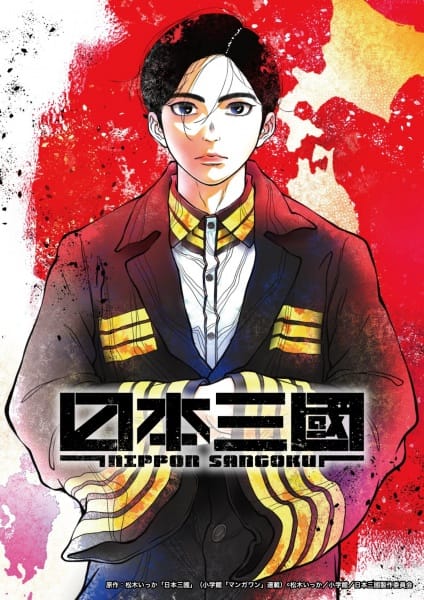
The world-building is meticulous without being tedious. Director Kazuaki Terasawa and writer Teruko Utsumi understand that you don’t need a twenty-minute lore dump when a well-placed argument between characters can reveal everything you need to know about a nation’s values. Every debate doubles as world-building, and that’s incredibly efficient storytelling. The way characters talk about their nations — with pride, with frustration, with the weariness of people who’ve inherited conflicts they didn’t start — tells you more about Yamato, Takeo, and Seii than any map or narrator ever could.
Aoteru Misumi: The Debate-Lord Protagonist We Needed
Let’s talk about Aoteru Misumi, because this character is doing something I’ve rarely seen in anime. Voiced by Kensho Ono with the kind of quiet intensity that makes every word feel weighted, Aoteru isn’t a fighter. He’s not secretly overpowered. He doesn’t have a hidden combat mode lurking behind those librarian glasses.
What Aoteru has is knowledge. History. Rhetoric. The ability to walk into a room full of warlords and dismantle their positions with citations and logic. He’s the kind of protagonist who wins by being the smartest person in the room and being willing to say so — which makes him deeply satisfying to watch and genuinely controversial within the world of the show.
In a season crowded with power fantasies, the show gives us a protagonist whose superpower is reading books and thinking about them. It’s refreshing. It’s risky. And three episodes in, it’s working better than I ever expected. Aoteru doesn’t win because the plot demands it — he wins because he’s done the research, because he understands the history that brought these nations to ruin, and because he genuinely believes that the alternative to persuasion is just more death. That conviction is magnetic.
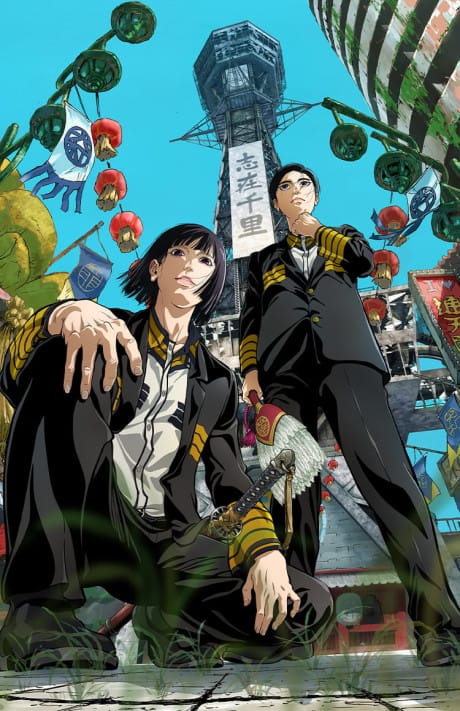
Aoteru’s motivation — reunifying a broken Japan through persuasion rather than force — feels almost naïve in a genre that usually rewards violence. But the show never treats his idealism as weakness. When his arguments fail, and they do, it stings. When they land, you feel the impact ripple through the room. This is what great political anime looks like: consequences that matter, won through conviction rather than power levels.
And can we appreciate that his name literally echoes the Romance of the Three Kingdoms archetype? Aoteru Misumi carries the weight of Zhuge Liang, the strategist who won with wit, but he’s also unmistakably his own character — shaped by loss, driven by a very Japanese understanding of what unity means after catastrophe. He’s not a transplant from Chinese literature — he’s what happens when that archetype meets a culture that has its own deep, complicated relationship with reconstruction and national identity.
The Rivalry That Carries the Show
If Aoteru is the brain, Yoshitsune Asama is the fist — and their ideological clash is the engine that drives this show forward. Voiced by Jun Fukuyama with his trademark charismatic edge, Yoshitsune believes in strength. Not as a villain’s cartoon justification, but as a genuine philosophy born from watching the weak get crushed over and over in a post-apocalyptic wasteland.
The dynamic between Aoteru and Yoshitsune isn’t good versus evil. It’s idealism versus pragmatism, and the show has the maturity to let both sides make compelling arguments. When they face off, you’re not rooting against Yoshitsune — you’re understanding why he thinks the way he does, even as you hope Aoteru can prove him wrong.
This is the same energy that made Lelouch vs Light legendary, but grounded in real political philosophy rather than supernatural power trips. It’s Code Geass for people who’d rather watch a debate than a mecha battle.
The supporting cast deepens every conflict they touch. Saki Higashimachi, Aoteru’s wife, isn’t a passive supporter — she’s street-smart, politically active, and capable of calling out Aoteru’s blind spots in ways he actually listens to. Asami Seto brings genuine warmth and steel to the role. Saki is the kind of partner who makes the protagonist better by existing, not by dying to motivate him. That matters more than I can articulate.
Then there’s Denki Taira (Takashi Nagasako bringing his A-game) and Yasuaki Kaku (Yuichi Nakamura doing that thing where he makes you trust a character instantly before making you question everything). The ensemble has that Golden Kamuy energy — weirdos and wildcards who somehow form a cohesive, compelling cast.
Studio Kafka’s Masterclass in Animation
I need to talk about how this anime looks, because Studio Kafka is not playing around. If you know their work on The Ancient Magus’ Bride and the Mononoke film, you know they can paint with light and shadow. But this? This is them operating on an entirely different level.
The character designs are expressive without being busy. The backgrounds are painterly and rich with texture — ruined skylines overgrown with vegetation, makeshift courtrooms built from salvaged materials, war councils held under storm-heavy skies. Every frame feels like it has history embedded in it, which is exactly what a story about rebuilding from catastrophe needs.
The debate scenes deserve special mention. When Aoteru speaks, the animation shifts — not into some flashy transformation sequence, but into something subtler. Camera angles tighten. The background noise drops. You feel the weight of his words through the visual direction alone. It’s the kind of storytelling-through-animation that most studios reserve for climactic fight scenes, and Studio Kafka is deploying it for conversations.
Kevin Penkin’s score deserves its own paragraph. The man who made Made in Abyss sound like wonder and terror having a child has now made political debate sound like war. Strings that sting. Percussion that punches. Silence deployed like a weapon. When the music swells during a pivotal argument in episode three, you’ll understand why this show has people comparing it to the best psychological anime of the past decade.
Produced by Twin Engine — the studio behind Vinland Saga — the production infrastructure matches the creative ambition. This isn’t a promising show that falls apart at episode six. Three episodes deep, and the quality has only escalated.
Why the Comparisons Hold Up
People keep comparing it to Legend of the Galactic Heroes, and I get it. The scope is there. The ideological warfare is there. The cast of characters with genuine philosophical disagreements is there. But this anime isn’t trying to be LOGH — it’s too specifically Japanese for that, too rooted in the question of what happens when a single nation tears itself apart rather than when two empires collide.
The Golden Kamuy comparison is more interesting and more accurate. Like Golden Kamuy, Nippon Sangoku builds its world through an ensemble of oddballs who shouldn’t work together but absolutely do. The humor is there — drier, more restrained, but present. The sense that history is being made by deeply flawed, deeply human people is there. If you loved Golden Kamuy’s cast chemistry, you’ll find the same DNA here.
And the Shōgun comparison? That one comes from the New York Times, which featured it alongside Witch Hat Atelier as a Spring 2026 standout. It’s not a stretch. The political maneuvering, the cultural specificity, the sense that every alliance is temporary and every peace is fragile — that’s Shōgun territory, and this show navigates it with confidence.
Kojima’s endorsement carries weight because he’s not someone who praises lightly. When he says a show is essential viewing, he means the storytelling operates on a level that rewards attention — that the narrative has layers worth unpacking. Three episodes in, I’m inclined to agree. The foreshadowing is dense without being obtuse. The callbacks to real historical patterns — Three Kingdoms, Sengoku period, post-war reconstruction — reward viewers who know the references but never exclude those who don’t.
The R-17+ Rating Isn’t Decoration
The series carries an R-17+ rating for violence and profanity, and it earns every bit of it. This isn’t edge for edge’s sake — the violence is the natural consequence of a world built on conflict, and the profanity is how real people talk when they’re angry, scared, or desperate.
The show doesn’t flinch from what post-apocalyptic warfare looks like. There are scenes of genuine brutality that serve the story — not torture porn, but the kind of violence that makes you understand why Aoteru’s pacifist approach is so radical and so necessary. When characters die, it hurts. When they suffer, you feel it. The R-17+ rating gives the show the freedom to be honest about its world.
This is also why it works as a post-apocalyptic anime that doesn’t feel like every other wasteland story. The apocalypse isn’t the point — it’s the backstory. The point is what comes after, and how people with fundamentally different visions for the future try to coexist when coexistence keeps failing. The show understands something that most post-apocalyptic fiction misses: rebuilding isn’t just about infrastructure — it’s about ideology. You can’t rebuild a nation if its people can’t agree on what the nation should be.
Three episodes in, the body count is low but the stakes feel enormous. That’s a hard balance to strike. Most anime either kill characters for shock value or protect them with plot armor so thick it suffocates the tension. The show threads the needle by making you care about the ideas at stake as much as the people — so even when nobody dies, something fundamental shifts in the power dynamics.
What Three Episodes Tell Us About the Full Season
With 12 episodes planned and only three aired as of April 22, 2026, we’re still early. But what we’ve seen so far tells a compelling story about where the show is headed.
Episode one established the world and Aoteru’s mission with remarkable economy. No twenty-minute prologue, no info-dump narrator — just a man in a ruined library making a choice that the show frames as both heroic and possibly delusional. Episode two introduced Yoshitsune as a philosophical counterweight and raised the stakes by showing exactly what Aoteru’s idealism costs in practice. Episode three delivered the first real debate climax, and it was electric.
The pacing is confident. Teruko Utsumi’s scripts know when to accelerate and when to let silence do the work. The show isn’t rushing to hit plot beats — it’s building a foundation that could support genuine payoffs down the line. That kind of patience is rare in a medium that often front-loads spectacle to hook audiences.
If the quality holds — and with this team, there’s every reason to believe it will — Nippon Sangoku won’t just be the standout of the Spring 2026 anime season. It could end up as one of the defining anime of the decade. The kind of show that reshapes what people think the medium can do with political storytelling.
The competition is strong this season. Our Spring 2026 anime streaming guide covers the full lineup, and there’s genuine quality across the board. But Nippon Sangoku is doing something nobody else is attempting — a debate anime that treats rhetoric as action, philosophy as conflict, and a librarian as the most dangerous person in the room. That’s not just different. That’s necessary.
You can stream Nippon Sangoku on Amazon Prime Video worldwide, and honestly, that accessibility is part of why the conversation around this show has exploded so fast. No gatekeeping, no regional lockouts — just a show that everyone can watch and everyone has an opinion about. Check the MAL page if you want to track the score’s trajectory, but I’d recommend just diving in.
Final Verdict: Don’t Sleep on This One
Here’s the bottom line: Nippon Sangoku is the real deal. A political anime with genuine intellectual weight, stunning animation from Studio Kafka, characters who feel like they exist beyond the screen, and a premise that uses its post-apocalyptic setting to explore ideas that matter.
Aoteru Misumi is the kind of protagonist we need more of — someone who believes that words can change the world and is willing to risk everything to prove it. Yoshitsune is the kind of rival who makes that belief meaningful by challenging it at every turn. And the world they inhabit is rich enough, complicated enough, and honest enough to make their conflict feel like it matters.
Three episodes. 8.45 on MAL. Kojima’s blessing. NYT recognition. And it’s only getting started. If you’ve been looking for an anime that respects your intelligence and rewards your attention, Nippon Sangoku is it. Clear your schedule, fire up Amazon Prime Video, and join the conversation — because this is the show everyone’s going to be talking about all season long. Whether you’re here for the political maneuvering, the stunning animation, or just the novelty of watching a librarian outmaneuver warlords with footnotes and conviction, Nippon Sangoku delivers on every front.
And hey, if Aoteru can try to reunify a shattered nation with nothing but knowledge and conviction, the least we can do is show up and watch him try.
You Might Also Enjoy
If Nippon Sangoku has you hooked on smart, politically charged anime with characters who fight with their minds, here are a few more shows worth your time:
Code Geass — The original “chessmaster protagonist reshapes a nation” anime, and still one of the best.
Lelouch vs Light — A deep dive into two of anime’s greatest strategic minds and what makes them tick.
Psycho-Pass — Political philosophy wrapped in a sci-fi thriller. If you loved Nippon Sangoku’s ideas-first approach, this one will hit the same notes.
Death Note — The debate anime before debate anime was a genre. Still holds up.
Best Psychological Anime — Our full guide to anime that makes you think, argue, and reconsider your positions.