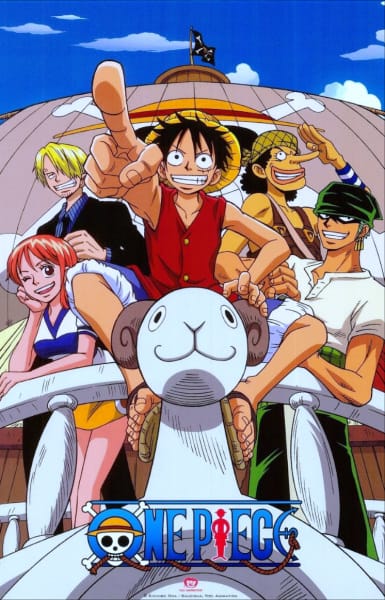
In over 1000 episodes of One Piece, we’ve watched Monkey D. Luffy grow from a reckless boy with a straw hat to an Emperor of the Sea. Yet somehow, through all his transformations and power-ups, Luffy has remained fundamentally the same character who punched a Sea King in chapter one. That consistency, combined with genuine evolution, makes Luffy one of the most well-developed protagonists in anime history.
The Dream That Started Everything
Luffy’s goal is deceptively simple: become King of the Pirates. But unlike other shonen protagonists chasing power or recognition, Luffy’s dream is about freedom. To him, the Pirate King is “the freest person on the sea”—someone beholden to no one, capable of going anywhere and doing anything.
This philosophy shapes every decision Luffy makes. He doesn’t want to conquer the world or rule over anyone. He simply wants the freedom to have adventures with his friends, eat great food, and punch anyone who threatens the people he cares about.
Shanks and the Straw Hat
Luffy’s journey began with Red-Haired Shanks, one of the Four Emperors. When Shanks sacrificed his arm to save young Luffy from a Sea King, he entrusted the boy with his signature straw hat—a symbol passed down from the legendary Pirate King, Gol D. Roger, himself.
That straw hat isn’t just an accessory. It’s a promise to reunite with Shanks as an equal, to become a pirate worthy of returning it. Every time Luffy protects that hat, he’s protecting his dream and his connection to the man who inspired him.
Early Luffy: Reckless but Pure
In the East Blue Saga, Luffy was at his most chaotic. He’d punch first and think never, making decisions based entirely on gut instinct and whether something seemed fun. His crew recruitment process consisted of “you seem cool, join me” with zero strategic thought.
Yet even early Luffy displayed the qualities that would make him a legend. His fight against Arlong wasn’t about defeating a powerful enemy—it was about making Nami smile after years of suffering. His battle with Captain Kuro was defending Usopp’s village. From the beginning, Luffy’s strength served his heart, not his ambition.
The Power of Inherited Will
Luffy’s existence connects to the broader themes of One Piece: inherited will, the dreams of men, and the shifting tides of the era. As a carrier of the “D” initial and son of Revolutionary Dragon, Luffy was born into a legacy of world-shakers.
But Luffy doesn’t fight for inherited responsibility. His “D” status and family connections are backgrounds to his character, not motivations. He carries the will of those who came before because he genuinely embodies their values—not because blood demands it.
The Gum-Gum Fruit’s True Nature
For most of One Piece, Luffy’s Devil Fruit seemed simple: the Gomu Gomu no Mi gave him a rubber body. Stretchy punches, immunity to bullets, and creative attack forms made Luffy a capable fighter, but his fruit was considered weak compared to logias or other paramecias.
Gear Transformations
Luffy’s genius lies in maximizing his “weak” fruit through Gear techniques:
Gear Second pumps blood at accelerated speeds, super-heating Luffy’s body and granting explosive speed at the cost of stamina.
Gear Third inflates his bones with air, creating giant limbs capable of devastating attacks at the cost of temporary shrinkage.
Gear Fourth combines armament haki with inflation, transforming Luffy into powerful forms like Boundman, Snakeman, and Tankman.
Gear Fifth awakens Luffy’s true power, revealing that his fruit was never the Gomu Gomu no Mi at all…
The Nika Revelation
In the Wano Arc, we learned the truth: Luffy ate the Hito Hito no Mi, Model: Nika—a mythical zoan fruit containing the spirit of the Sun God Nika, a liberator figure spoken of only in legend. Gear Fifth transforms Luffy into “Warrior of Liberation,” granting him reality-warping cartoon physics.
This revelation recontextualizes everything. Luffy’s rubber powers were always the passive abilities of a god. His infectious laughter and ability to draw allies were aspects of Nika’s nature. The World Government’s pursuit of this fruit explains their unusual interest in Luffy since the beginning.
Yet the awakening feels earned because Luffy reached it through his own growth, not destiny. The Nika fruit chose to awaken in Luffy because he embodied its values—freedom, joy, and liberation.
Haki Mastery: The Colors of the Supreme King
Luffy possesses all three types of Haki, including the rare Conqueror’s Haki (Haoshoku), which only one in several million people can use.
Observation Haki
Luffy’s Observation Haki developed significantly in Whole Cake Island, where he briefly achieved Future Sight during his battle with Katakuri. This ability to glimpse upcoming events allowed him to battle opponents who were otherwise faster than him.
Armament Haki
Starting from his training with Rayleigh, Luffy’s Armament Haki evolved from basic hardening to advanced applications. He learned to emit Haki (Ryuo) in Wano, allowing his strikes to damage enemies from within rather than through direct impact.
Conqueror’s Haki: Coating
The ultimate expression of Luffy’s Conqueror’s Haki came when he learned to coat his attacks with it, joining an elite group that includes Kaido, Big Mom, Shanks, and Whitebeard. This technique multiplies attack power exponentially and was the key to defeating Kaido.
Evolution of Leadership
Early Luffy was a terrible captain by traditional standards. He’d charge into danger without plans, make decisions based on hunger, and treat serious situations as games. Yet his crew followed him with absolute loyalty.
Over time, Luffy learned to trust his crew more explicitly. The separation at Sabaody taught him that his weakness endangered his friends. The timeskip training showed growth in acknowledging his limitations. Post-timeskip Luffy still makes impulsive decisions, but with better understanding of consequences.
The Emperor
After defeating Kaido, Luffy was recognized as one of the Four Emperors. This status wasn’t just about power—it represented the massive alliance and territory Luffy had accumulated: the Straw Hat Grand Fleet, alliances with Wano and Fishman Island, and influence across the New World.
Luffy handles this responsibility characteristically: by mostly ignoring it. He doesn’t want to conquer territories or command armies. The fleet exists because its members chose to follow him, not because he sought power.
Key Relationships and Growth
Crew Dynamics
Luffy’s relationship with each Straw Hat reflects different aspects of his character. Zoro represents unwavering loyalty and shared dreams. Nami grounds him in reality (literally hitting him when he’s stupid). Usopp shares his childlike spirit and occasionally challenges his decisions, as seen in Water 7.
The Usopp conflict was crucial for Luffy’s development. Being forced to fight his friend over the Going Merry taught Luffy about necessary leadership decisions—sometimes captains must make choices that hurt.
Ace and Loss
Ace’s death at Marineford fundamentally changed Luffy. For the first time, his strength wasn’t enough to save someone he loved. The brother who always protected him died in his arms, and Luffy couldn’t do anything.
This trauma drove the timeskip training. Post-timeskip Luffy is still joyful and carefree, but there’s an underlying seriousness about protecting his crew. He’ll never again watch someone he loves die because he was too weak.
Philosophy and Worldview
Luffy’s morality is simple but consistent. He doesn’t care about government designations of good and evil. Marines can be allies if they share his values; pirates can be enemies if they’re cruel. What matters is whether someone tries to control others’ freedom.
Liberation as Theme
Every arc in One Piece features Luffy liberating someone or something. He frees islands from tyrants, rescues friends from imprisonment, and breaks chains both literal and metaphorical. The Nika revelation confirms this was always core to his character—he’s the Warrior of Liberation not because of his fruit, but because liberation is who he is.
Luffy’s Impact on One Piece
One Piece wouldn’t work with a different protagonist. Luffy’s unique combination of simplicity and depth, goofiness and determination, sets the tone for the entire series. His ability to make allies everywhere allows Oda to expand the world organically. His refusal to kill allows villains to return as allies. His pursuit of fun over glory makes even serious arcs feel adventurous.
Conclusion
Monkey D. Luffy has grown from a reckless boy to an Emperor of the Sea, but he’s done so while remaining true to his core values. He still wants to be the freest person on the sea. He still puts his friends above everything. He still laughs in the face of danger.
What’s changed is his ability to protect what matters. Early Luffy had the heart of a Pirate King but not the strength. Current Luffy has grown into a force that can challenge anyone who threatens his crew or their freedom. The dream remains the same—only now, he can actually achieve it.
As One Piece enters its final saga, Luffy stands ready to claim the title he’s been chasing since chapter one. And when he does, it won’t be because destiny chose him. It will be because a rubber boy never stopped reaching for his dreams, stretching toward freedom until he grasped it.
You Might Also Like
- Nico Robin: One Piece’s Most Heartbreaking Backstory
- Anya’s Powers Explained: Telepathy, Limitations, and Origin Theories in Spy x Family
- Anya’s Powers Explained: Telepathy, Limitations, and Origin Theories in Spy x Family