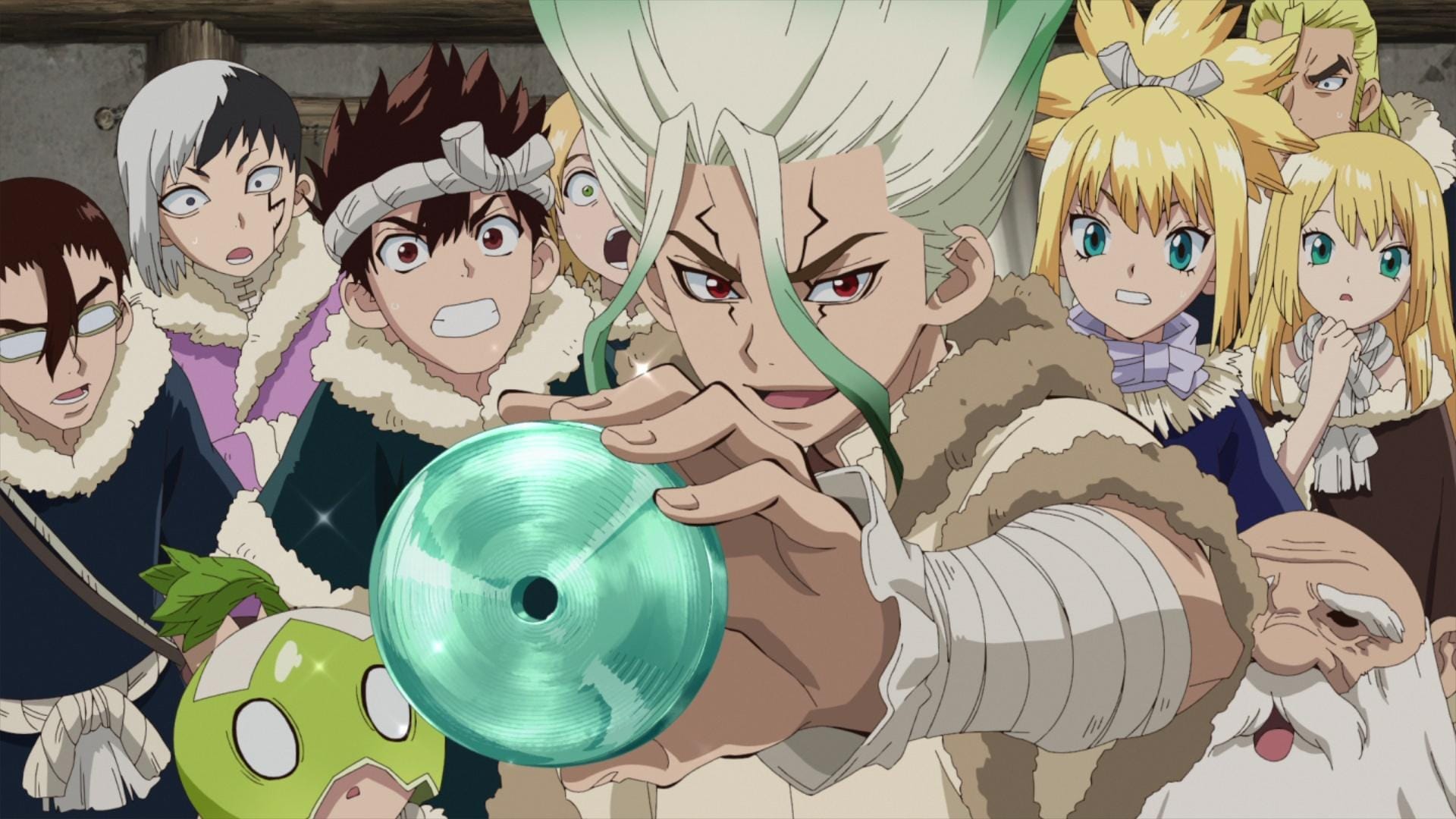
There’s a specific kind of joy that comes from watching a character solve a problem with their brain instead of their fists. Not the usual anime bravado — no power-ups, no screaming at the sky until your hair turns gold. Just a kid with an absurd IQ, a pile of rocks, and the entire history of human civilization rattling around inside his skull. That’s Dr. Stone. And when Riichiro Inagaki and Boichi’s manga wrapped in 2022, followed by the anime’s New World arc, it left behind something genuinely rare: a shonen series that made you smarter just for watching it.
The Dr. Stone legacy in science anime is already being written. Not just because it was popular — plenty of popular anime fade fast. But because it changed what the genre is allowed to be.
The Science Problem Anime Never Solved (Until Now)
Science and anime have always had an awkward relationship. Plenty of series traffic in pseudo-science — technobabble, fictional physics, made-up elements that sound cool but mean nothing. Think of the entire Gundam franchise, or the energy-manipulation hand-waving in Naruto. These aren’t criticisms; anime has always used science as a flavoring agent, not an ingredient.
Even the shows that tried harder — Steins;Gate with its time travel theory, Cells at Work with its immunology — hit a ceiling. Steins;Gate’s science is fascinating but ultimately serves its thriller plot. Cells at Work is educational in the same way a really good museum exhibit is: engaging, but safely simplified. Both are brilliant. Neither changed what science means in the context of shonen storytelling.
Dr. Stone came along and said: what if the science wasn’t the flavor? What if it was the whole point?
Inagaki structured the manga — and by extension the anime — around actual scientific processes. Senku doesn’t wave his hands and produce penicillin. He sources mold, explains why certain strains work, and walks you through the fermentation logic. The show adapted real-world timelines and discovery sequences with surprising fidelity. Nitric acid from hot springs. Nital for metal etching. The progression from stone tools to gunpowder to electricity follows a loose but recognizable arc of human technological history.
That’s new. That’s genuinely, historically new for the genre.
Senku Ishigami: The Protagonist Shonen Didn’t Know It Needed
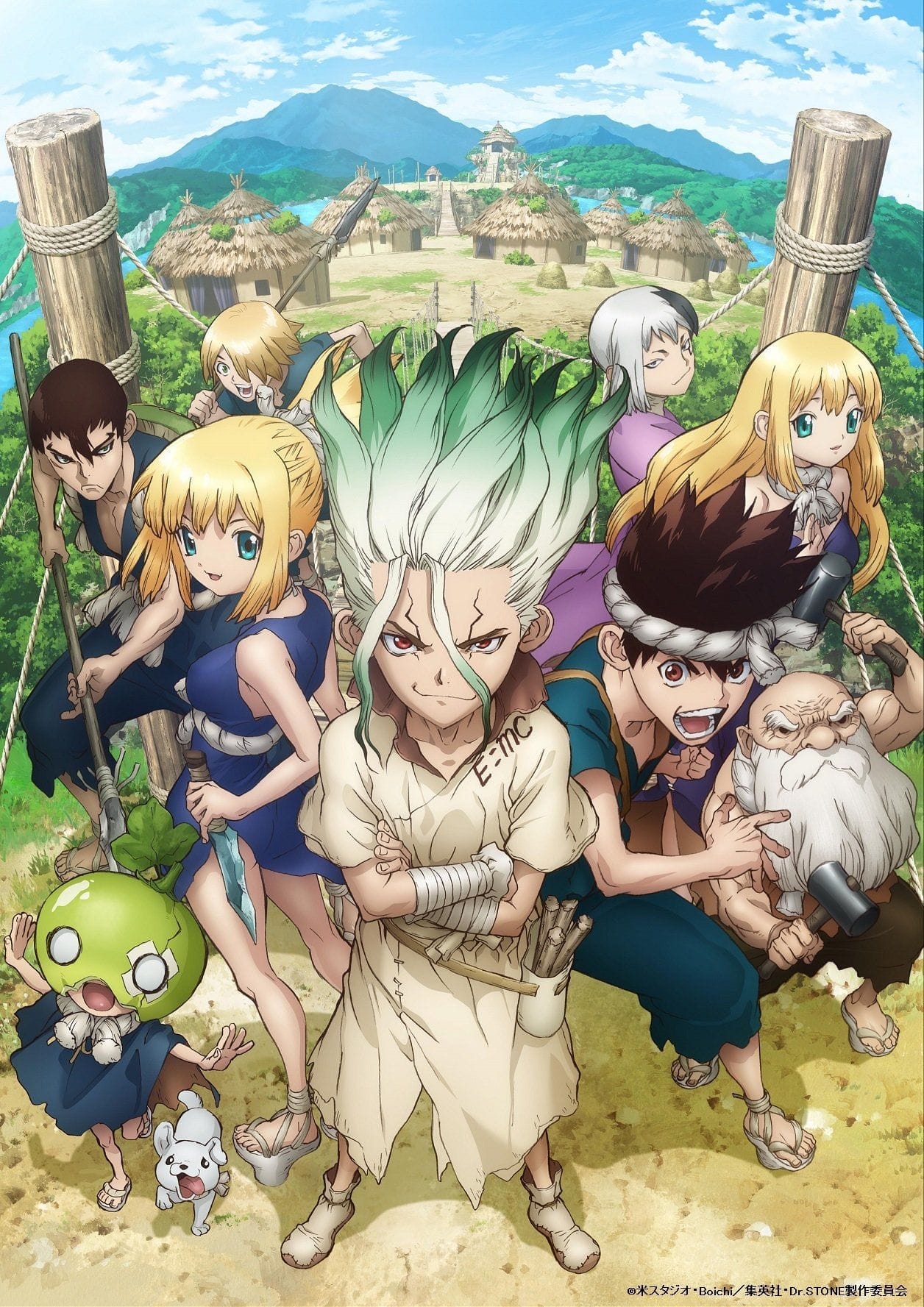
Let’s talk about Senku, because he’s the entire thesis statement of this show made flesh.
Shonen has a protagonist problem. Not a fatal one — the archetype works, which is why it persists — but a recognizable one. The hot-blooded underdog who grows through grit and friendship is a sturdy narrative machine. Naruto, Luffy, Deku, Asta: all variations on the same chassis. You root for them because they want something badly and refuse to stop. The emotional engine is desire plus persistence.
Senku runs on a completely different fuel. He is already the smartest person in the room — in any room, including rooms that contain the entire civilization he’s rebuilding from scratch. He doesn’t grow more capable over the course of the story. He was already at the top. What he grows in is something more interesting: he learns to trust people to be capable, to delegate, to understand that science is fundamentally a collaborative act.
This flips the classic shonen structure. Instead of the protagonist climbing toward greatness, he’s pulling everyone else up with him. The satisfaction isn’t watching Senku get stronger. It’s watching him hand someone else a tool — literal or conceptual — and watching that person transform. Chrome’s arc from superstitious rock-collector to proto-scientist is one of the best “student surpasses the apprentice level” beats the genre has delivered in years, precisely because Senku’s goal was always to make Chrome not need him.
That’s a radically different hero. And it worked. Senku became one of the most cosplayed, discussed, and memed characters of his generation — not despite being a nerdy know-it-all, but because of it. The “ten billion percent” catchphrase alone became shorthand for confident intellectual energy across the internet.
You can’t overstate how significant that cultural moment is. The cool kid in anime — the one millions of teenagers wanted to be — was a scientist.
The Educational Engine: Did It Actually Teach You Something?
Here’s a question that gets asked a lot about Dr. Stone, and deserves a straight answer: is the science actually accurate?
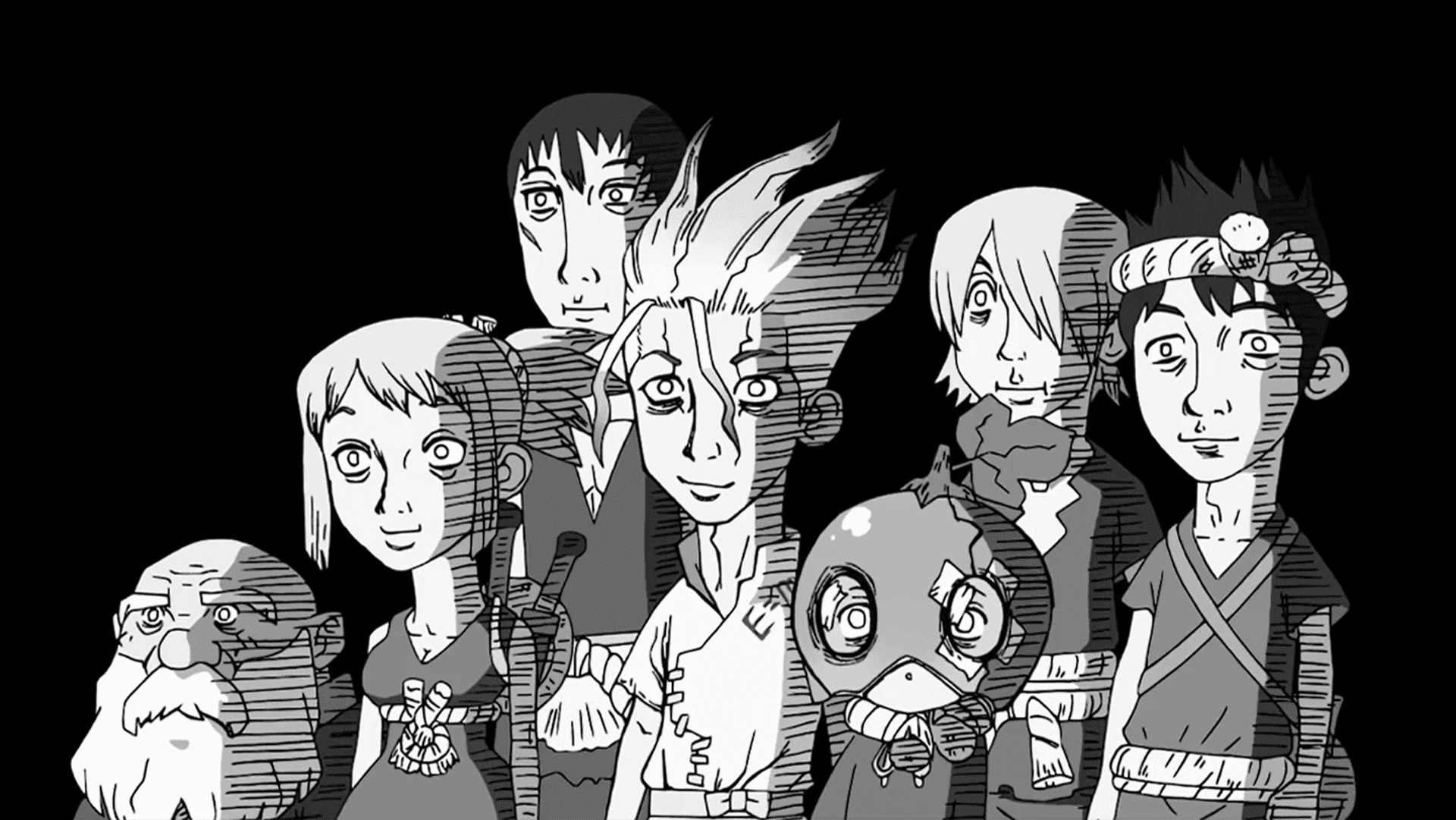
Mostly, yes — with appropriate caveats. The broad strokes are real. The show’s depiction of making glass, producing alcohol, isolating sulfuric acid, and eventually constructing rudimentary electronics follows genuine processes. The timelines are compressed, the difficulty is softened, and some steps are glossed over in ways that would make actual chemists twitch. But the underlying logic is sound enough that watching the show is genuinely educational in a way that sticks.
There’s a reason high school science teachers were recommending the series to students. A Reddit thread in r/DrStone became a minor phenomenon when a chemistry teacher posted explaining exactly how much of Season 1’s science she’d verified with her class. The answer: a lot of it. The broad strokes of the stone-to-civilization arc track with real archaeological timelines, particularly the transition from stone tools to bronze age metallurgy.
More importantly, the show teaches scientific thinking even when it fudges the details. Senku doesn’t just announce solutions — he hypothesizes, tests, fails, and iterates. That’s the scientific method, rendered in anime form, for 24 minutes a week. Tons of shonen series preach the value of hard work. Dr. Stone preached the value of iteration, evidence, and not trusting your gut when you can run an experiment instead.
That’s an educational posture, and it’s a meaningful one to embed in entertainment consumed by millions of teenagers.
How It Stacks Up Against the Science Anime Canon
Comparing Dr. Stone to its predecessors is a useful exercise for understanding exactly what it did differently.

Steins;Gate is the gold standard for science-as-plot in anime. Its treatment of time travel is philosophically sophisticated, emotionally devastating, and constructed with the internal consistency of a well-oiled machine. But it’s fundamentally a thriller that uses science as its mechanism. You don’t come away from Steins;Gate understanding time travel better. You come away wrecked by the human cost of trying to change fate.
Cells at Work is genuine science education packaged as action-comedy. It’s brilliant at what it does — the immunology depicted is surprisingly accurate, and the show has been credited with helping people understand their own bodies. But it operates at a different scale. Its science is observational: here is what platelets do, here is the digestive system. Dr. Stone’s science is applied: here is how you bend chemistry to human will.
Moyashimon (Tales of Agriculture) is an underrated entry in the science-adjacent anime space. It depicts microbiology and fermentation with genuine nerdery. But it never found a mainstream audience and its educational content was always secondary to its college-life dramedy structure.
Dr. Stone sits at an intersection none of these reached: the mainstream shonen format with genuine applied science as its protagonist’s primary weapon. It didn’t choose between being educational and being entertaining. It made them the same thing. That synthesis is what makes it unique — and what makes the Dr. Stone legacy in science anime so durable.
For a broader look at how 2026’s anime season is building on this foundation of genre experimentation, check out our complete guide to the Spring 2026 anime season — there are a few titles clearly in Dr. Stone’s debt.
New World and the Weight of an Ending: What Part 3 Accomplished
New World — the anime’s third and final season — was always going to carry impossible expectations. The manga’s ending divided fans. Any time a beloved series wraps, you get factionalism: people who loved the resolution, people who wanted more, people who felt the final arc rushed things it shouldn’t have.
Having sat with it long enough to think clearly: the New World arc accomplished something genuinely difficult. It scaled the story from a small survival narrative to a global civilization-restoration project without losing the show’s soul. Senku’s mission going planetary — literally sailing to other petrified civilizations around the world — was the right choice narratively. It made explicit what the show had always been implicitly about: science isn’t a local achievement. It belongs to everyone, or it belongs to no one.
The finale’s emotional core — the question of whether rebuilding civilization is worth it, and what you sacrifice in the process — landed with more weight than I expected. Senku, for all his genius, is still a teenager who spent several thousand years as a stone statue. The show never lets you forget that. The ending honors both his capability and his humanity, which is exactly the balance the character required.
We went deep on the specific implications of the final chapter in our Dr. Stone Part 3 final chapter breakdown — including what that ending means for the Kingdom of Science’s future and Senku’s legacy in-universe.
What the New World arc confirmed, above all, is that Dr. Stone always knew what kind of story it was. It never pivoted to action for action’s sake. The final confrontations were still fundamentally about science versus force, knowledge versus raw power. It ended the only way it could — with Senku out-thinking the problem rather than overpowering it.
The Manga’s Cultural Footprint: What Happened Beyond the Anime
The manga deserves its own analysis, separate from the anime, because Boichi’s visual contribution to Dr. Stone is genuinely underappreciated in discussions of its legacy.
Inagaki wrote a smart story. Boichi made it viscerally gorgeous. The decision to depict stone-age chemistry and metallurgy as visually dramatic — the splash pages where Senku synthesizes something, the kinetic energy in discovery sequences — is what made the educational content land for a visual medium. Science in manga form is hard to make exciting. Boichi found a way to render the moment of chemical reaction as something that hits like a punch to the chest.
The manga ran in Weekly Shonen Jump from 2017 to 2022 — five years of consistent publication with strong sales throughout. It moved over 10 million copies globally, which places it firmly in the second tier of Jump hits: not Demon Slayer numbers, but solidly in the conversation. More importantly, its readership skewed toward people who were already interested in science, which created an unusually engaged fan community that cross-pollinated with STEM communities online.
The chemistry community on YouTube and Reddit engaged with the manga in ways that hadn’t really happened with a shonen title before. Actual chemists made breakdown videos. Science educators used chapters in lesson plans. The American Association for the Advancement of Science ran a piece examining the show’s scientific accuracy — the kind of institutional attention that anime rarely generates outside of cultural-phenomenon-level events.
That crossover is part of the cultural footprint. Dr. Stone didn’t just reach anime fans. It reached people who don’t typically watch anime, because the hook — science as survival tool — was universal enough to travel.
Where Dr. Stone Sits in Shonen History
Shonen history gets written in eras, and it’s usually retrospective. You rarely know you’re in a defining moment while it’s happening.
But enough time has passed now to say something definitive about what Dr. Stone represents in the timeline of the genre. It belongs to the generation of Jump titles that expanded what shonen protagonists are allowed to be — alongside Haikyu’s reframing of sports anime, Demon Slayer’s visual maximalism, and My Hero Academia’s superhero deconstruction. These shows didn’t kill the old archetypes. They proved the genre was spacious enough to hold something genuinely new.
Dr. Stone’s specific contribution is the intellectualization of shonen heroism. Before Senku, you could name on one hand the number of shonen leads whose primary power was scientific knowledge. The genre prized physical ability, emotional willpower, and social bonds — all present in Dr. Stone too, but subordinate to cognition in a way that had never been attempted at this scale and with this level of success.
What comes next is the interesting question. We’re already seeing more science-adjacent concepts creeping into mainstream shonen — a direct lineage is hard to prove, but the genre is clearly more comfortable with intellectual protagonists than it was in 2016. Whether that’s Dr. Stone’s influence or a broader cultural shift toward STEM is genuinely hard to separate. But the timing is suggestive.
We’ve argued elsewhere that we may be living through a golden age of anime — and Dr. Stone is part of the evidence for that claim. Not because it’s the best anime of its generation (that argument is exhausting and probably unanswerable), but because its existence proves the genre’s capacity for genuine innovation at mass scale.
A show about science — real science, applied science, science as the protagonist’s superpower — ran in Weekly Shonen Jump, got a full anime adaptation, moved 10 million copies, got STEM educators excited, made “ten billion percent” a phrase teenagers use unironically, and ended with a conclusion that honored everything the series built.
That’s not a small thing. That’s the genre expanding to include something it didn’t know it needed.
The Lasting Question: Did It Change Science Anime Forever?
The word “forever” is doing a lot of work in that headline, so let’s be honest about what it actually means.
Dr. Stone didn’t create a new genre. Science anime existed before it and will continue to evolve independently of it. What it did is prove a specific proposition that had never been fully tested: you can build a mainstream shonen series around genuine science, refuse to simplify it past the point of honesty, make the scientist the coolest character in the room, and millions of people will follow you there.
That proof of concept matters. When the next showrunner or mangaka wants to pitch something science-heavy to a mainstream audience, they now have a data point. They have a precedent. They can point to Dr. Stone and say: here is what’s possible. Here is the audience that exists and didn’t know it wanted this.
In that sense, yes — it changed things. Not by replacing what came before, but by adding a verified blueprint for something that hadn’t worked before at this scale. The Dr. Stone legacy in science anime is, ultimately, a legacy of permission. It gave the genre permission to be smarter than it thought it had to be.
Senku would say something like: “That’s ten billion percent the right call.” And for once, the hyperbole is actually underselling it.