There’s a specific kind of cool that doesn’t try. It just exists — loose-limbed and half-lidded, cigarette dangling, moving like someone who’s already made peace with whatever comes next. That’s Spike Spiegel. Any honest Spike Spiegel character analysis has to start with the same uncomfortable admission: this guy shouldn’t work as well as he does. He’s laconic to the point of rudeness, allergic to effort, and living so far inside his own past that the present barely registers. And yet, twenty-five-plus years after Cowboy Bebop first aired, Spike remains the benchmark. Not just for anime cool characters, but for cool in fiction, full stop.
This is an attempt to figure out why.
Who Is Spike Spiegel, Really?
On the surface, Spike Spiegel is a space bounty hunter — a Cowboy Bebop protagonist drifting through the solar system on a ship called the Bebop, tracking down criminals for whatever reward money might cover the next meal. He’s tall, perpetually rumpled, possessed of a gravity-defying hair situation and a right eye that’s artificial. He doesn’t sleep enough. He eats whatever Jet puts in front of him without comment. He smokes too much.
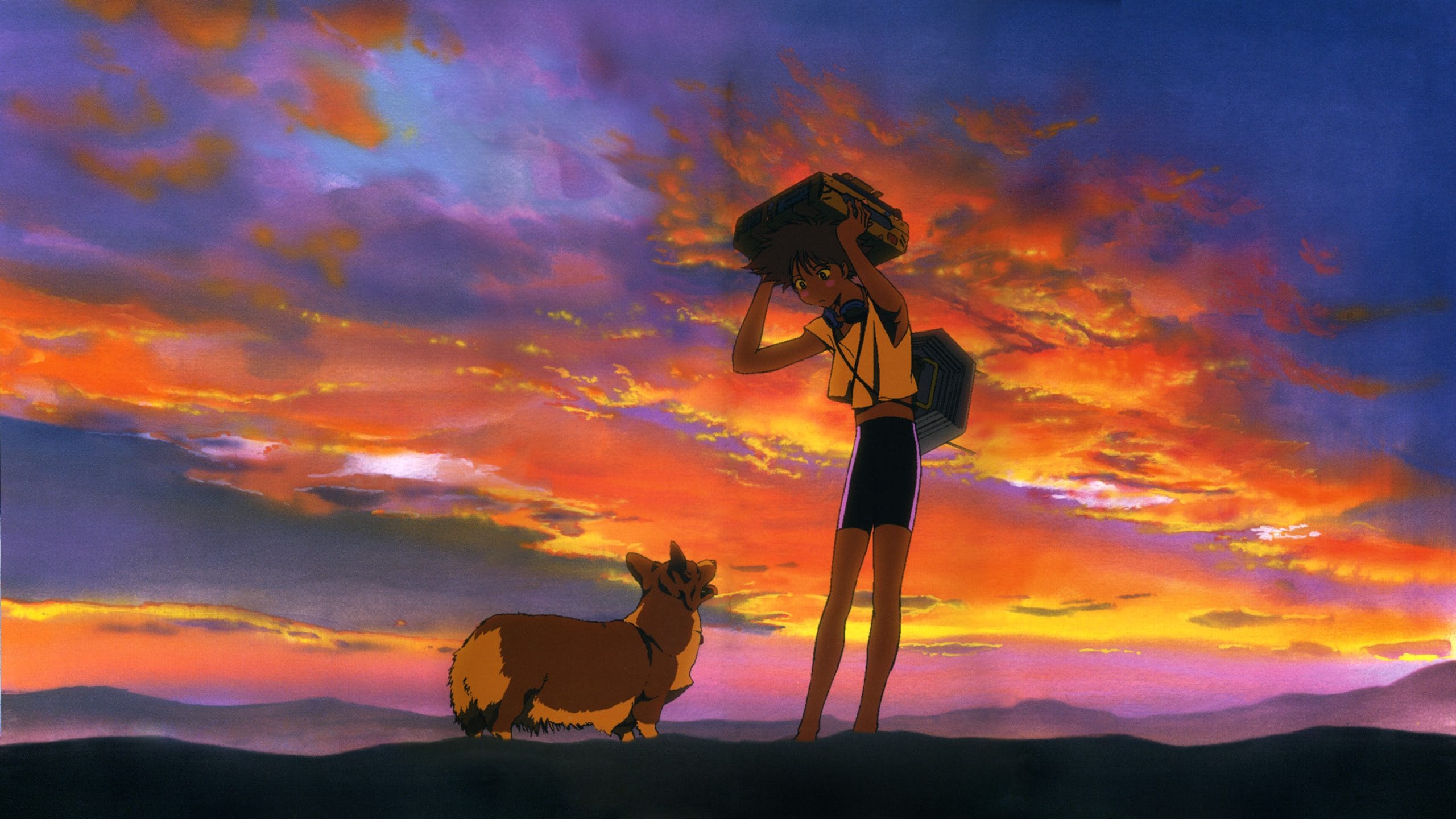
But that’s the shell. Underneath it — and the show makes you work to see this — Spike is a man who died once and hasn’t quite figured out what to do with the extra time. He was a hitman for the Red Dragon Syndicate, one of the most feared criminal organizations in the solar system. He was trained from adolescence to be a weapon. He fell in love with a woman named Julia, and when that love threatened the organization, everything fell apart in the bloodiest way possible. Spike faked his death, cut ties with everything, and reinvented himself as a bounty hunter. He floats. He coasts. He tells himself none of it matters.
The tell is in how he talks about his eye. The artificial one sees the present clearly. The real one, he says, only sees the past. It’s the kind of line that reads as throwaway until you realize he’s not being poetic — he’s being precise. Spike genuinely cannot stop looking backward. Every bounty they chase, every mark they corner, every near-death experience in the Swordfish II, it all slides off him. None of it is real. Only what he left behind feels real.
That’s not cool for coolness’s sake. That’s a portrait of a man running from grief at several hundred knots per hour.
The Philosophy: Bruce Lee, Water, and Not Trying Too Hard
Spike’s fighting style is Jeet Kune Do — the martial art developed by Bruce Lee, based on the principle of having no fixed style. Be like water. Adapt to the container. Don’t commit to a single form because a single form can be anticipated, countered, broken. Jeet Kune Do is fundamentally anti-dogma: it takes what works, discards what doesn’t, and stays fluid.
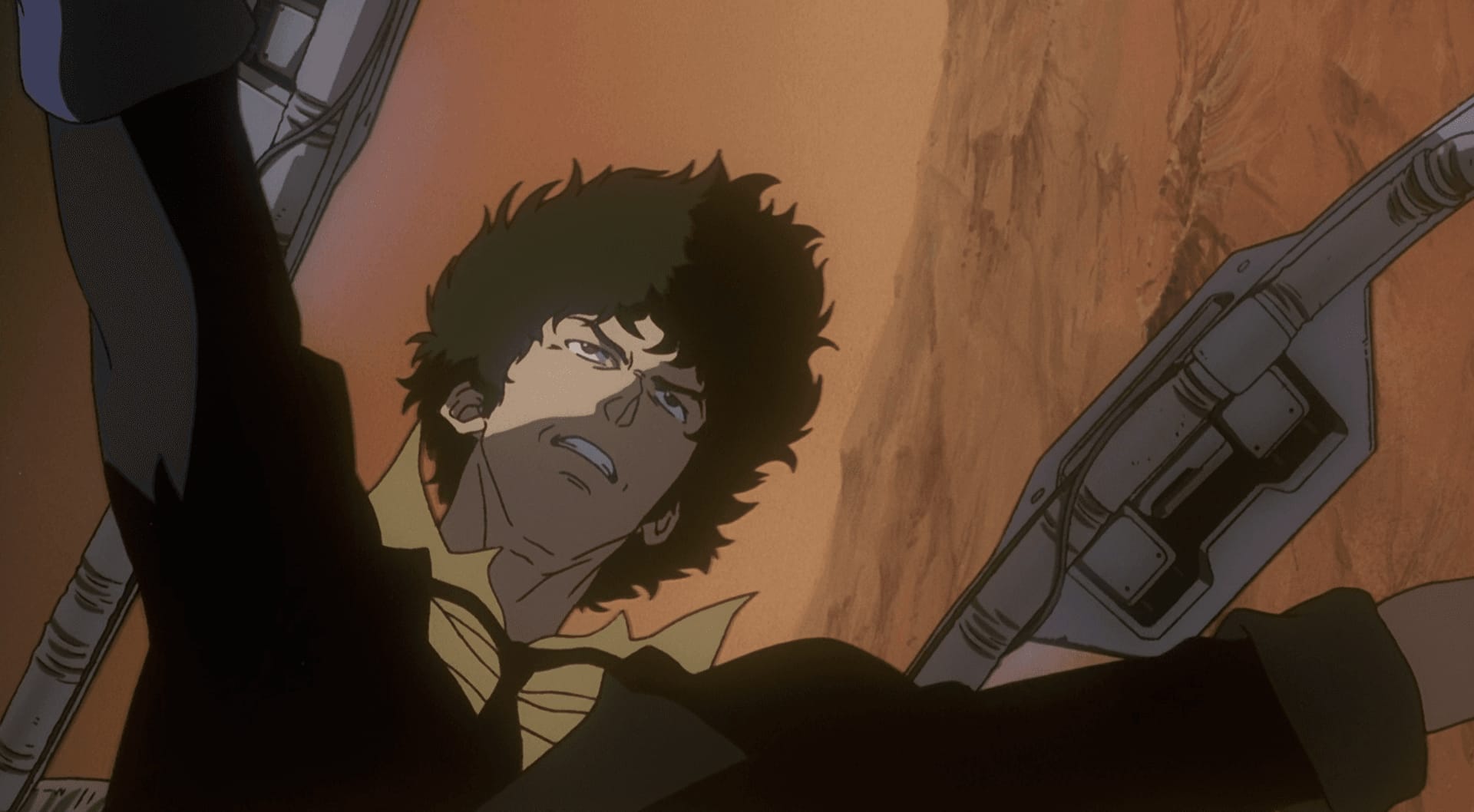
The show chose this deliberately. Spike isn’t a brawler. He’s not a technician. He fights the way he lives — improvised, relaxed, economical. He doesn’t waste motion. He doesn’t get dramatic. When the violence comes, it just happens, and then it’s done, and Spike goes back to looking like he’s thinking about something else entirely.
Bruce Lee’s influence on Spike goes deeper than the fighting style, though. Lee famously rejected the idea of a fixed identity — he thought of himself as a student of life rather than a practitioner of any single discipline. Spike operates the same way. He has no ambitions. No five-year plan. No ideology. He takes jobs when they come. He helps people when helping requires less energy than explaining why he won’t. He doesn’t attach to outcomes because outcomes belong to the future, and the future, for Spike, is a fiction.
“I’m not going there to die,” he tells Jet near the end. “I’m going to find out if I’m really alive.”
That’s the water philosophy applied to existence. Not clinging. Not resisting. Just moving toward the shape of things and seeing what you are when you get there.
What makes this land rather than read as nihilism is that Spike actually cares — he’s just conditioned himself not to show it. He risks his life for Ed when he doesn’t have to. He keeps showing up for Faye. He and Jet bicker constantly in that particular way two people bicker when they trust each other completely. The detachment is armor, not philosophy. But the philosophy is what makes the armor look good.
Vicious, Julia, and the Weight of the Past
You can’t do a proper Spike Spiegel character analysis without sitting with the Vicious problem, because Vicious is what Spike could have been — and maybe what part of him still is.
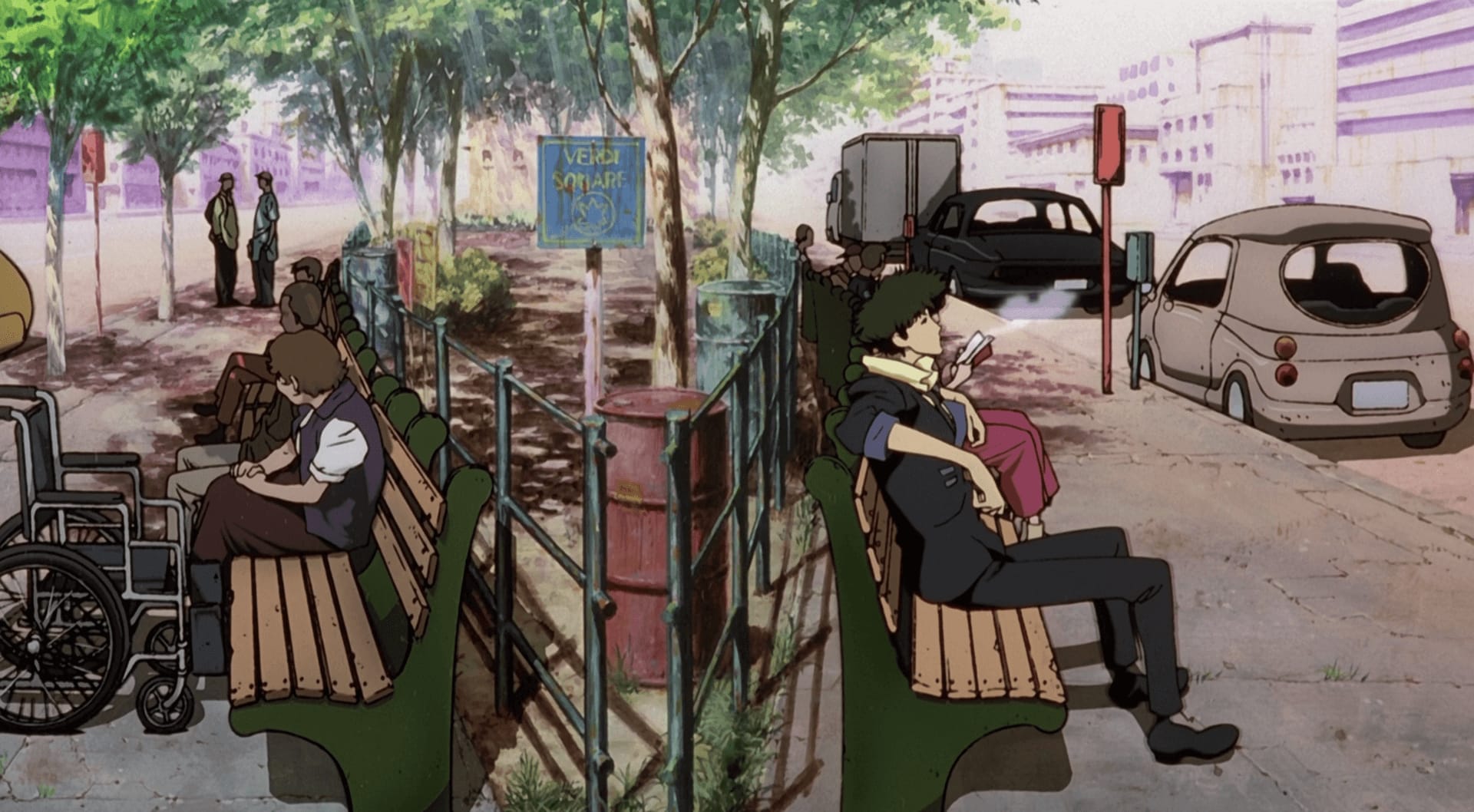
Where Spike became water, Vicious became stone. They were partners in the Red Dragon Syndicate. Whatever they were to each other — friends, rivals, something darker — it calcified into something irreconcilable once Julia entered the picture. Julia was Vicious’s woman. Spike fell for her. She fell back. They made a plan to run away together, and when Vicious found out, he gave Julia an ultimatum: kill Spike, or both of them would be killed. Julia disappeared instead of making that choice. Spike, believing she’d betrayed him, faked his death and walked away from the only life he’d ever known.
So Spike carries two things: the grief of losing Julia, and the confusion of never knowing why she vanished. He tells himself he’s over it. He’s not over it. Everything about his behavior in the series — the casual death-seeking, the way he goes still when Julia’s name comes up, the complete absence of plans for any future — it all flows from that original fracture.
Vicious, for his part, is Spike’s shadow made literal. He is what happens when you absorb all that same violence and pain and instead of going loose with it, you go rigid. He speaks in grand pronouncements. He carries a sword. He has the aesthetic of a man who has decided his suffering makes him special. Spike finds this embarrassing, which is probably the most honest emotional reaction in the whole show.
Their final confrontation is inevitable from the first episode. Not because the plot demands it, but because Spike has always been walking toward it. The Red Dragon Syndicate, Vicious, Julia — they’re not obstacles. They’re the destination. Spike left his past unfinished, and unfinished pasts have a way of turning around and coming for you.
Julia, when she finally appears in earnest, is deliberately underwritten — a figure more myth than person by the time Spike reaches her. The show knows this. It’s the point. Spike isn’t in love with a person anymore. He’s in love with a memory, a version of a life he almost had. When Julia dies, there’s nothing left to go back to. There’s only forward, toward Vicious, toward the ending.
The Fight Choreography: Action as Biography
A lot of anime fight scenes exist to be spectacular. Cowboy Bebop’s fights exist to be true. Spike doesn’t power up. There’s no transformation sequence. He doesn’t get dramatically wounded and fight through it on willpower alone. He bleeds, he stumbles, he takes damage that looks like it hurts, and he keeps moving anyway — not out of heroism but out of something closer to stubbornness.
The Jeet Kune Do choreography gives his fights a quality you don’t often see in animation: they look like a real person fighting, not a superhero. Spike uses his reach. He reads his opponents. He slips punches rather than blocking them — again, water, not stone. When he hits, it’s efficient. When he gets hit, he moves with it rather than absorbing it rigidly.
Shinichirō Watanabe, the director, was meticulous about this. The team studied real martial arts footage extensively. The goal wasn’t impressiveness — it was believability in service of character. Every fight tells you something about Spike. The casual confidence when he’s outmatched. The slight loosening of control when things get personal. The way he almost looks bored until he suddenly isn’t.
The Church fight in Ballad of Fallen Angels — where Spike crashes through a stained-glass window in slow motion, falling through sacred imagery while bleeding out — is probably the most purely cinematic single moment the show produces. It’s choreography as poetry. He doesn’t look heroic. He looks like a man falling. Which is exactly what he is.
Even the Swordfish II sequences carry this through. Spike’s dogfighting style is loose, instinctive, and slightly reckless in ways that mirror his hand-to-hand work. He doesn’t fly safe. He flies toward the problem and trusts his reactions to handle whatever comes next. It works, until it doesn’t.
The Ending and What It Actually Means
“You’re gonna carry that weight.”
The words appear on screen just before the credits of the final episode. They’re borrowed from the Beatles — there’s a piece of music in the show by that name — but they carry their full meaning here. The crew of the Bebop scatter. Spike goes to settle things with Vicious. He fights his way through the Red Dragon compound, gets shot more times than anyone should survive, reaches Vicious, kills him. Then walks back out into the light.
Does he die? The show doesn’t confirm it. What it shows you is Spike looking up at the stars, a small light going out, and then darkness. The fan debate has run for decades and will probably keep running. But the question misses what the ending is actually doing.
Whether Spike lives or dies is beside the point. What matters is that he chose. For the entire series, Spike has been drifting — carried along by whatever shows up, refusing to commit to a future because futures require you to be alive to inhabit them. In the final episodes, he stops drifting. He goes toward something, not away from it. He makes a choice, which is the one thing the old Spike never did.
That’s not a death wish. That’s the act of a man finally deciding to take up the space he’s in. The outcome is almost secondary to the fact that he showed up at all.
It’s a gutting ending precisely because it’s earned. Twenty-six episodes of watching someone refuse to live, followed by one episode of watching them try — even if trying costs everything. The weight the show tells you you’re going to carry isn’t grief for a fictional character. It’s the recognition of something true about how people get lost, and what it costs to find your way back.
Spike Spiegel’s Legacy: The Standard That Hasn’t Moved
In the decades since Cowboy Bebop first aired on Japan’s TV Tokyo in 1998 — and then detonated on Western audiences via Adult Swim — the conversation around anime cool characters has never really moved past Spike. Not because nobody has tried. People have tried constantly. But Spike operates at a frequency that’s hard to replicate because he’s built on a specific kind of restraint that most character designers shy away from.
He doesn’t want anything the plot can give him. He’s not chasing power, recognition, love, or survival. He’s chasing a reckoning that may or may not end him, and he’s doing it at his own pace, in his own style, without making a big deal about it. That’s the hardest character note to hit — genuine indifference to outcome combined with genuine engagement in the moment — and Spike hits it consistently.
The space bounty hunter setup is a genius frame for this. Bounty hunting is by nature episodic, low-stakes in the grand scheme, slightly absurd. Each job is self-contained. You collect or you don’t. There’s no larger meaning. That structure lets Spike be Spike — drifting through a series of encounters that mean nothing to him, each one slowly revealing why everything used to mean too much.
His influence shows up everywhere. You see him in the DNA of Mugen from Samurai Champloo (same director, deliberate spiritual successor). You see him in the morally adrift protagonists of Trigun, Black Lagoon, 91 Days. You see him in the quiet reluctance of characters like Levi Ackerman — people who are extraordinarily capable and entirely unbothered about proving it. Even in Western media, the archetype keeps showing up: the capable loner running from a past too big to carry, making dry remarks until the moment it all comes due.
The Netflix live-action adaptation proved the point by negative example. John Cho is a compelling actor and gave everything to the role, but the production couldn’t resist explaining Spike — giving him monologues, making his trauma legible, scripting out what the anime trusted silence to convey. The result was a technically accomplished version of the character that felt nothing like him. Cool, it turns out, is mostly what you don’t say.
Spike Spiegel doesn’t lecture you about how life is short or how the past is a trap. He just lives — badly, beautifully, all the way to the edge — and lets you figure it out yourself. That’s the lesson and the legacy, and it still holds.
You Might Also Enjoy
- Vicious From Cowboy Bebop: The Mirror That Spike Couldn’t Look Away From
- Mugen vs. Jin: Two Sides of the Same Wanderer in Samurai Champloo
- Why Cowboy Bebop’s Ending Still Hits After 25 Years
- The 10 Best Anime Series for People Who Think They Don’t Like Anime
- Edward Wong and the Joy That Cowboy Bebop Almost Forgot to Have