The Question That Still Starts Arguments: Is Light Yagami a Villain?
Ask any Death Note fan whether is Light Yagami a villain and you’ll get into a fight within sixty seconds. That’s not an exaggeration — it’s basically the franchise’s superpower. Few anime characters in history have split audiences so cleanly down the middle, and fewer still have held that tension for over two decades. Light Yagami debuted in 2003, and people are still arguing about him in comment sections, Discord servers, and college philosophy classes. That staying power doesn’t happen by accident.

What makes Light so fascinating — and so genuinely hard to pin down — is that the show gives you everything you need to love him and everything you need to despise him. It never blinks. It never hedges. It puts the full picture in front of you and dares you to draw your own conclusion. So let’s actually do that. Let’s take the case for villain, the case for anti-hero, and figure out where the truth lands.
The Case Against Light — Why He’s the Villain, Full Stop
Let’s be honest about what Light Yagami actually does over the course of Death Note. He discovers a supernatural notebook that kills anyone whose name is written in it. His first instinct isn’t to report it, destroy it, or hand it over to someone else. His first instinct is to use it. Within days, he’s executing criminals. Within weeks, he’s convinced himself he’s a god.

The argument for Light as a straightforward anime villain rests on a simple foundation: the moment he made his first kill, he crossed a line he never came back from. It wasn’t self-defense. It wasn’t an accident. It was a deliberate, calculated decision to end a human life — even if that human was a violent criminal — based entirely on his own judgment. No trial. No due process. No oversight. Just Light Yagami deciding who deserves to live.
And it escalates fast. Light doesn’t just kill criminals from a distance and go to bed with a clean conscience. He manipulates people. He engineers suicides. He kills an FBI agent named Raye Penber and then uses Penber’s fiance — a woman named Naomi Misora who was completely innocent — to gather information before writing her name in the notebook too. Naomi never hurt anyone. She was just someone who got too close to the truth. Light didn’t hesitate.
This is the core villain argument: Light’s stated goal of creating a utopia without crime is not what he’s actually building. What he’s actually building is a world where he decides who lives and who dies, permanently, without appeal. That’s not justice. That’s tyranny with a supernatural toolkit. The road to hell is paved with ideological certainty, and Light Yagami is sprinting down it while patting himself on the back.
By the end of the series, Light has murdered not just criminals but detectives, police officers, loyal allies, and anyone else who became inconvenient. The body count includes people who trusted him, people who helped him, and people who genuinely cared about him. If you look at what he does rather than what he says, the villain label fits cleanly.
The Case For Light — Fallen Idealist or Genuine Anti-Hero?
Here’s where it gets complicated. Because the other reading of Light Yagami — the one that makes him one of the most compelling Death Note protagonists in anime history — is that he starts from a real place. The world he lives in is genuinely broken. Criminals walk free. Repeat offenders continue to hurt people. The justice system fails victims constantly. Light sees this and decides someone has to do something about it.
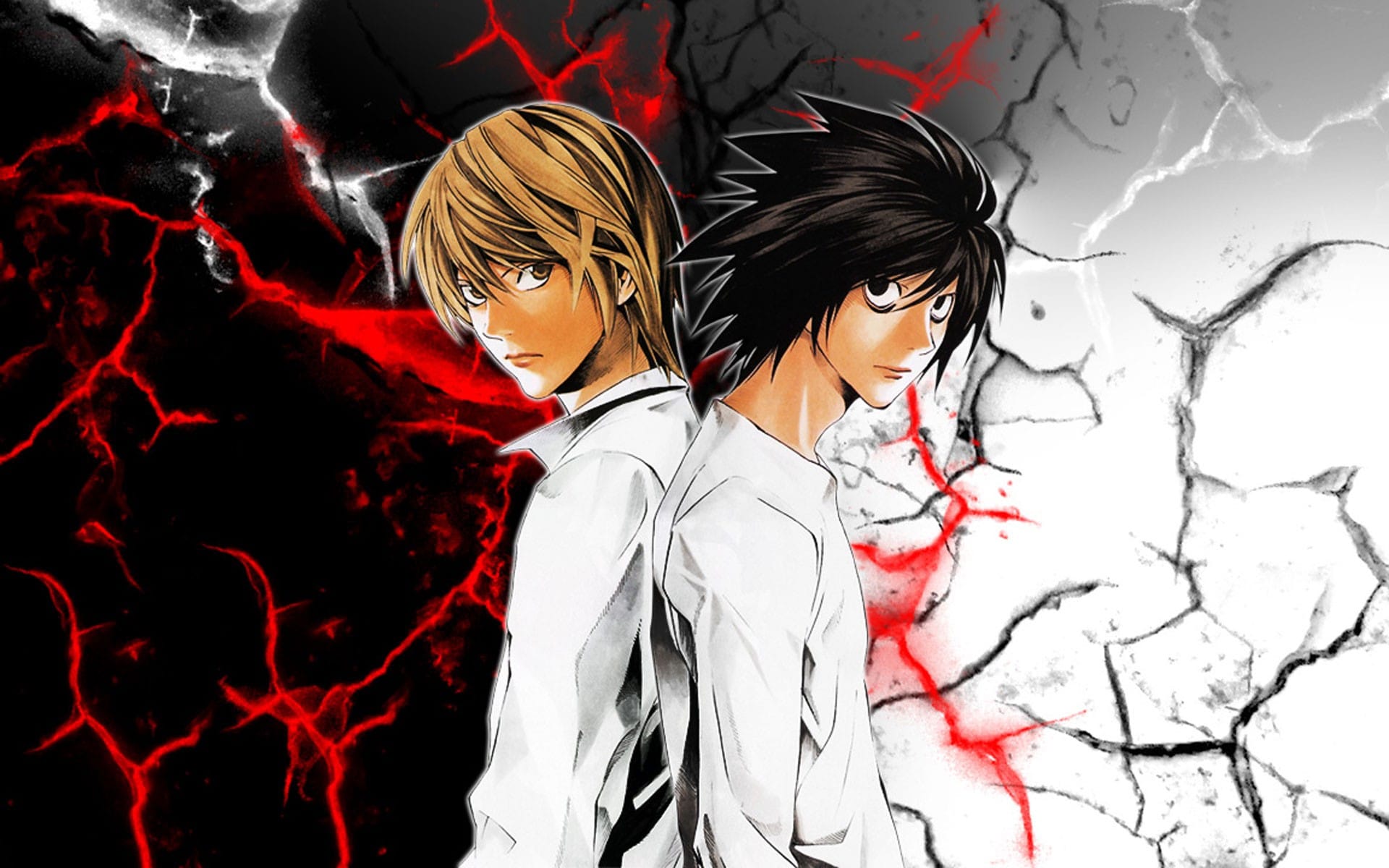
The anti-hero anime tradition is built on characters who pursue good ends through questionable means. Walter White, Tony Soprano, Macbeth — Western storytelling is full of them. Light fits that mold in his early stages. The first criminals he kills are genuinely terrible people. The world does get measurably safer in the months after Kira emerges. Crime rates drop globally within the Death Note universe. That’s not nothing.
There’s also the question of moral ambiguity in the tools themselves. The Death Note is a supernatural object dropped into the human world by a bored shinigami. It’s not Light’s fault it exists. He didn’t create it. He didn’t ask for it. He found it, and then had to decide what to do with a weapon capable of eliminating suffering on a massive scale. The argument goes: isn’t it morally worse to find that power and not use it to reduce suffering?
The pro-Light camp also points to his intelligence and discipline as traits we’re supposed to admire. He’s not chaotic. He’s not cruel for cruelty’s sake. Every move Light makes is calculated, logical, and in service of a larger vision. He’s playing chess when everyone else is playing checkers. The show frames his cat-and-mouse with L as genuinely thrilling — and we’re rooting for Light as much as we’re rooting for L, often more. That emotional investment is the show acknowledging something real about his appeal.
Defenders of Light often land here: he was a brilliant, compassionate kid who found a weapon of mass moral consequence and made increasingly compromised choices trying to use it for good. He didn’t start as a monster. He became one. And the tragedy of that transformation is what earns him the anti-hero label rather than pure villain status.
How Death Note Deliberately Frames Its Protagonist
Tsugumi Ohba and Takeshi Obata — the manga’s writer and artist — are not passive here. They made very specific choices about how to present Light Yagami, and those choices shape how we read him. The series opens with Light narrating in a way that invites identification. He’s smart, bored, and disgusted by the state of the world. These are emotions the audience is meant to share, at least initially.
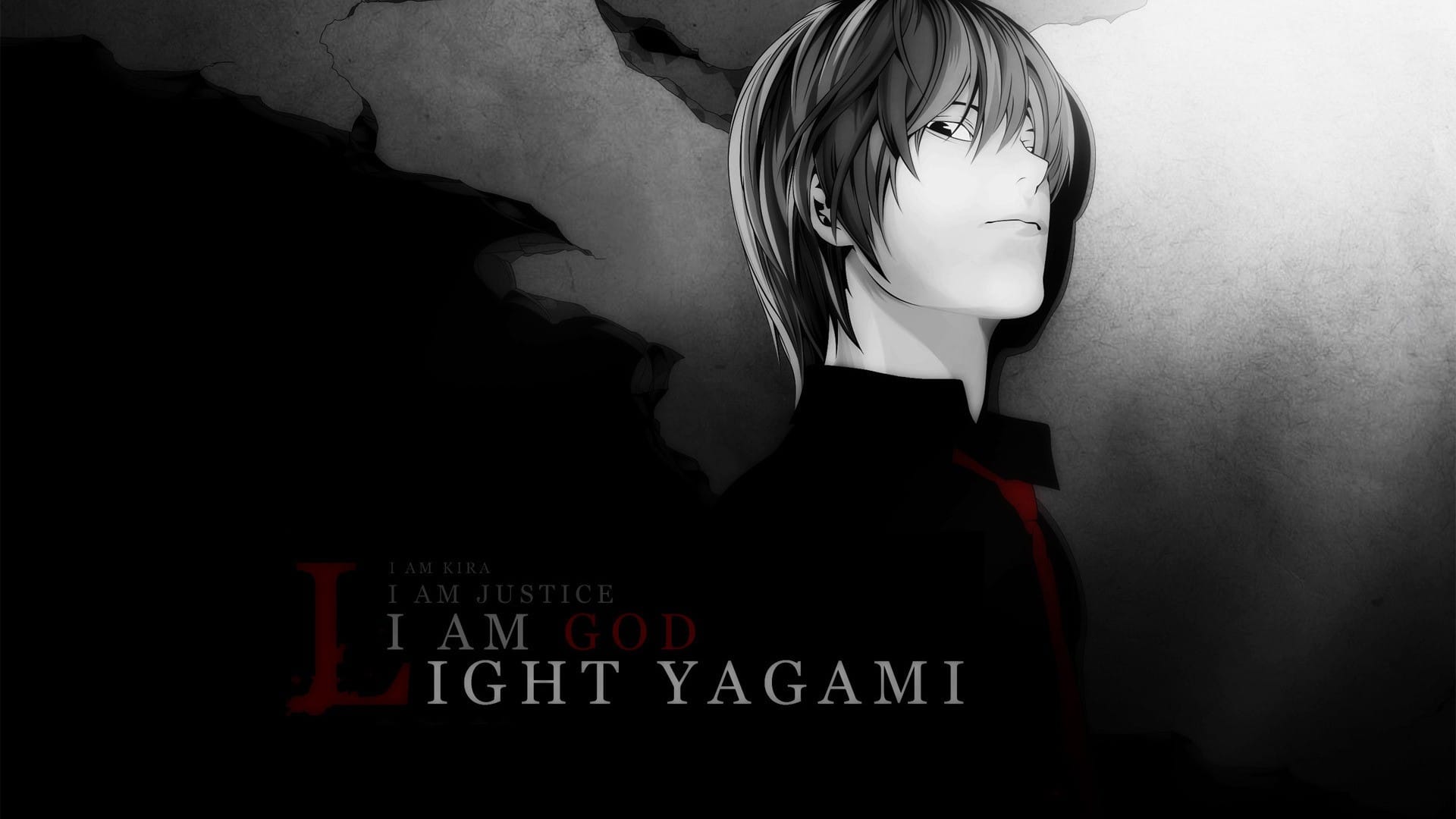
The show consistently gives Light the most stylish presentation. The dramatic lighting, the operatic musical cues during his monologues, the visual language of genius — all of it flatters him aesthetically even when his actions are indefensible. This is intentional. Ohba has said in interviews that he wanted readers to feel complicit. If you’re excited by Light’s wins, you’ve already been enrolled in his worldview whether you meant to be or not.
But the series is also ruthlessly honest about where that worldview leads. Ryuk — the shinigami who dropped the Death Note — tells Light at the very beginning: “I’m not on your side. I’m not on anyone’s side.” Ryuk is the show’s Greek chorus, and his neutrality is the show’s moral position. He observes Light with amusement and zero admiration. When Light finally loses, Ryuk writes his name in his own notebook without sentiment. Light dies scared and alone, begging for his life — the exact opposite of the god he imagined himself to be.
That ending is the show’s verdict. Ohba and Obata don’t present Light’s death as a tragedy of a hero cut down too soon. They present it as the logical conclusion of his choices. The visual of Light crawling across a stairwell, bleeding, pleading, is deliberately pathetic. It’s designed to strip away every inch of the cool mythology he built around himself. The show gives you the glamour and then makes you watch it dissolve.
The Moral Philosophy — What Kira’s Crusade Actually Argues
Death Note is, at its core, a philosophical text wearing a thriller’s clothes. The central question it’s asking isn’t just “is Light Yagami a villain?” — it’s asking whether the ends can ever justify the means, and whether any individual has the right to appoint themselves the arbiter of justice for the entire human race.
Philosophers have a term for Light’s ethical framework: consequentialism. The idea that moral value is determined by outcomes, not methods. If killing criminals reduces overall suffering, then killing criminals is morally justified. On paper, the math works. In practice, consequentialism runs into a wall the moment you have to decide who’s doing the calculating — and what happens when the calculator starts to factor in their own ego, their own survival, their own increasingly warped sense of what the world should look like.
Light fails as a consequentialist precisely because he isn’t actually optimizing for the world’s wellbeing. He’s optimizing for his own continued power and the confirmation of his own righteousness. By midway through the series, he’s killing people who threaten him personally, not people who threaten society. The original premise — reduce crime, protect the innocent — has become pure rationalization for self-preservation. He’s not Kira the god of justice anymore. He’s just a man who very badly does not want to be caught.
The show implicitly argues for a deontological counter-position: some actions are wrong regardless of their consequences. Killing an innocent person is wrong even if it protects your mission. Manipulating and destroying people who trust you is wrong even if your ultimate goal is noble. L embodies this position without ever explicitly stating it — he operates within rules, accepts constraints, and refuses to compromise on process even when bending those rules might make his job easier. L is the moral foil Light never acknowledges.
There’s also a deeply uncomfortable democratic argument buried in Death Note. Light is, essentially, a vigilante who was never elected, never accountable, and never subject to oversight. His vision for humanity was never debated or consented to. He just decided. For all his intelligence, this is the most naive thing about him: the belief that his judgment is so obviously superior that it doesn’t require the consent of the people it affects. That’s not utopia. That’s dictatorship with a supernatural cover story.
What the Fan Debate Actually Reveals About Us
Here’s something worth sitting with: the fact that this debate is so passionate and so ongoing says something about the audience, not just the character. Light Yagami resonates with people — especially young people encountering Death Note for the first time — because he gives voice to a feeling that’s very human and very real: I could fix this if they’d just let me.
That frustration with systems that feel broken, with institutions that seem corrupt, with suffering that seems preventable — that’s not a character flaw. It’s an understandable response to the world. Light takes it to a monstrous extreme, but the seed of it is recognizable. People who defend him often aren’t defending mass murder. They’re defending the emotion underneath it: the desire to make things better, the rage at inefficiency, the fantasy of having the power to actually fix something.
The fans who call Light a pure villain are often responding to a different truth: that this kind of thinking, left unchecked, produces real-world disasters. History is full of people who believed their judgment was correct enough to override everyone else’s. It rarely ends well. The discomfort with Light isn’t just moral squeamishness — it’s pattern recognition. We’ve seen where this goes.
And then there are fans who simply love Light because the show is more fun when he wins. This is also legitimate. Death Note is structured like a heist movie or a chess match — watching a brilliant mind execute a plan gives the same dopamine hit regardless of whether the plan is morally defensible. Enjoying Light’s victories doesn’t make you a bad person. It makes you the exact audience Ohba and Obata were writing for.
The Verdict: Where Light Yagami Actually Lands
After all of it — the philosophy, the framing, the body count, the fan debate — here’s where the honest answer lands: Light Yagami is a villain who began as a potential anti-hero. He’s not one or the other cleanly, and the tension between those readings is exactly what makes him one of anime’s most enduring characters.
He starts with something real: genuine moral concern and extraordinary capability. That combination, in different circumstances, might have produced something genuinely heroic. But the Death Note doesn’t exist in different circumstances. It exists in this story, with this version of Light — a person whose intelligence was always accompanied by arrogance, whose idealism was always shadowed by ego. The notebook didn’t corrupt him from the outside. It gave internal flaws external consequences at a massive scale.
By the end, Light is unambiguously the antagonist. Not because his original goal was wrong, but because the person he became in pursuit of that goal had abandoned every principle that might have made the goal worth pursuing. He’s a cautionary tale wrapped in a compelling character study, and the fact that he’s still so watchable, so seductive, so easy to root for in moments — that’s the point. Villains who feel like villains from the start teach you nothing. Villains who feel like heroes, right up until they don’t — those are the ones that actually make you think.
Is Light Yagami a villain? Yes. But he’s the kind of villain that holds a mirror up to something real, and that’s why we’re still talking about him more than twenty years later.
You Might Also Enjoy
- L Lawliet: The Detective Who Matched a God — A Full Character Breakdown
- The 15 Best Anti-Hero Anime of All Time, Ranked
- Death Note’s Ending Explained: What Really Happened to Light Yagami
- 10 Anime That Will Make You Question Everything You Thought Was Right and Wrong
- Ryuk Explained: What Does the Shinigami Really Want in Death Note?