Zoro’s Full Power Explained: Every Sword Technique Ranked
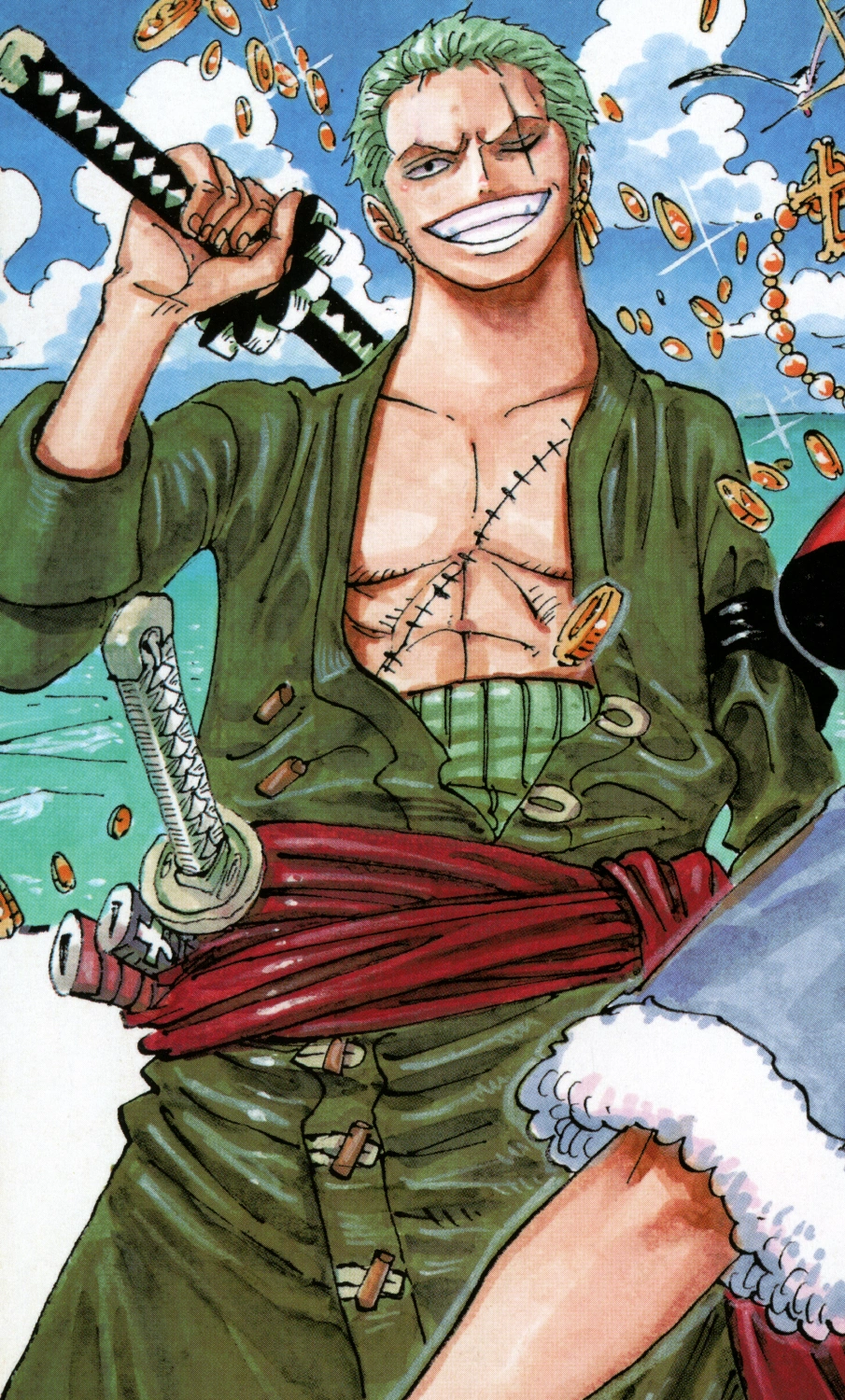
In the vast ocean of One Piece characters, Roronoa Zoro stands as an immovable pillar of strength, loyalty, and sheer determination. As the first crew member to join Monkey D. Luffy on his journey to become King of the Pirates, Zoro has evolved from a bounty hunter with a dream into one of the most formidable swordsmen the world has ever seen. His goal? To defeat Dracule Mihawk and claim the title of World’s Greatest Swordsman.
What makes Zoro truly special isn’t just his raw power—it’s the innovative fighting style he developed entirely on his own. The Three Sword Style, or Santoryu, is a combat technique that seems impossible on paper but becomes devastatingly effective in Zoro’s hands. Over two decades of storytelling, Eiichiro Oda has blessed us with countless Zoro techniques, each more impressive than the last. From basic slashes that cleave through steel to reality-bending attacks that can wound Emperors, Zoro’s arsenal has grown to match the threats facing the Straw Hat crew.
This comprehensive guide breaks down every significant technique, explains the mechanics behind his abilities, and ranks his most powerful moves. Whether you’re a longtime fan or new to the series, prepare to understand why Roronoa Zoro is considered one of anime’s greatest swordsmen.
⚠️ Spoiler Warning: This article covers Zoro’s abilities through the Wano Country arc and includes major plot developments.
Background & Origins
Roronoa Zoro’s journey began in Shimotsuki Village, where he trained at a local dojo with an unwavering determination to become the strongest. His rivalry with Kuina, the dojo master’s daughter, shaped his entire worldview. Despite training relentlessly, challenging her over two thousand times, Zoro could never defeat her—until her tragic death in an accident forced him to carry both their dreams forward.
Zoro made a vow that day: he would become so strong that his name would reach the heavens. He inherited Kuina’s sword, the Wado Ichimonji, and developed his signature Three Sword Style to honor her memory. This sword remains his most precious possession, a constant reminder of his promise and the person who first showed him what true skill looked like.
The development of Santoryu came from Zoro’s unique philosophy. Two swords in his hands represented his own ambition. The third in his mouth represented Kuina’s dream that he now carried. Combined, they formed a style no one else could replicate—not because of physical impossibility, but because no one else bore the same emotional weight behind each blade.
Before meeting Luffy, Zoro earned a reputation as the “Pirate Hunter,” taking down pirates for bounties while honing his skills. This wasn’t out of loyalty to the Marines; Zoro simply needed money for food and saw pirates as convenient targets who wouldn’t be missed. His fearsome reputation made him a target for Marines and pirates alike, eventually leading to his capture by Captain Morgan’s forces—and his fateful meeting with Monkey D. Luffy, who would change the course of his life forever.
Powers & Abilities
Zoro possesses no Devil Fruit powers, making his achievements even more remarkable. Everything he accomplishes comes from pure physical training, willpower, and mastery of the sword. In a world where people eat magical fruits to gain superhuman abilities, Zoro reaches the same heights through discipline alone. Let’s break down his complete arsenal.
Santoryu (Three Sword Style)
The foundation of Zoro’s combat ability, Santoryu involves wielding three swords simultaneously—one in each hand and one in his mouth. This seemingly absurd style becomes a weapon of mass destruction in Zoro’s hands. The jaw strength required to maintain a blade during high-speed combat would shatter normal teeth, yet Zoro executes complex maneuvers without dropping his third weapon.
Oni Giri (Demon Slash): One of Zoro’s earliest and most reliable techniques. He crosses his arm-held swords across his chest and places the third in his mouth, then slashes all three simultaneously as he passes through his opponent. The resulting X-shaped wound pattern is often fatal. Zoro has used variations of this technique throughout the series, enhancing it with Haki as his powers grew.
Tora Gari (Tiger Hunt): Zoro puts one sword in his mouth pointing to his left, holds a second with his right hand in a reverse grip, and holds the third normally. He then rushes forward, slashing with all three in a tiger-claw pattern. The technique’s name references the hunting patterns of great cats, and its application mirrors that predatory efficiency—striking before prey can react.
Santoryu Ogi: Sanzen Sekai (Three Thousand Worlds): One of Zoro’s ultimate techniques, first used against Mihawk at Baratie. He holds two swords horizontally above his shoulder and one in his mouth, then spins rapidly like a tornado while cutting through everything in his path. Against Mihawk, this technique proved insufficient, but it has since grown to match Zoro’s increasing power.
Tatsumaki (Dragon Twister): Zoro spins rapidly, creating an actual cyclone of cutting wind. This technique can deflect projectiles, cut multiple enemies simultaneously, and launch opponents into the air. Its versatility makes it useful in various combat situations.
Nitoryu (Two Sword Style)
When circumstances demand it—loss of a sword, environmental constraints, or tactical preference—Zoro can fight with devastating effectiveness using only two blades.
Nigiri (Two Slashes): The basis for many two-sword combinations, involving precise dual slashes that create X-shaped wounds similar to Oni Giri but with slightly different attack patterns.
Rashomon: Named after the famous gate, Zoro cuts through obstacles with both swords in a single powerful motion, capable of slicing through steel and stone. This technique demonstrated Zoro’s ability to cut materials previously thought immune to blades.
Nitoryu Iai: Rashomon: An iaido-style attack where Zoro sheaths his swords and draws them instantly for a powerful cutting attack. The iaido variant emphasizes the speed of the draw itself, condensing power into a single explosive motion.
Ittoryu (One Sword Style)
Even with a single blade, Zoro remains incredibly dangerous. His one-sword techniques often serve as finishers or for situations requiring precision over raw power. These techniques demonstrate that Zoro’s skill isn’t dependent on multiple weapons—each sword is deadly on its own.
Ittoryu Iai: Shishi Sonson (Lion’s Song): One of Zoro’s most iconic techniques. He sheathes his sword and draws it with incredible speed, cutting through his opponent before they can react. This technique first defeated Mr. 1, a man whose body was made of steel, and marked Zoro’s first breakthrough in cutting things previously thought uncuttable.
Yakkodori (Disaster Harbor Bird): A flying slash attack that sends a cutting wave toward distant enemies. This technique proved Zoro could engage opponents without physical contact, expanding his combat range significantly.
Daishinkan (Great Dragon Shock): A powerful overhead strike that Zoro uses to maximize cutting power against durable opponents. The technique channels all his strength into a single downward motion.
Kyutoryu: Asura (Nine Sword Style)
Perhaps Zoro’s most mysterious ability, Asura manifests what appears to be a demonic illusion—Zoro seems to grow two additional heads and four additional arms, allowing him to wield nine swords simultaneously. The nature of this transformation remains unexplained, though theories abound.
Asura Ichibugin (Asura: One Mist Silver): The attacking form of Asura, where Zoro delivers nine simultaneous slashes. This technique has felled some of the strongest opponents in the series, including Kaku of CP9, who was completely overwhelmed despite his Six Powers training.
The nature of Asura remains debated among fans. Is it a manifestation of Zoro’s willpower? A latent Conqueror’s Haki ability? Some form of cursed sword influence? Oda has kept this deliberately mysterious, adding to Zoro’s mystique as a swordsman who may possess powers beyond normal human comprehension.
Haki Abilities
Zoro has awakened all three forms of Haki, cementing his status among the world’s elite fighters. His Haki development places him alongside Emperors and Admirals in terms of spiritual power.
Observation Haki (Kenbunshoku): While not his specialty, Zoro can sense presences and predict attacks. He demonstrated this ability when sensing the presence of fishmen underwater during the Fishman Island arc. His Observation Haki tends toward sensing danger and killing intent rather than future sight.
Armament Haki (Busoshoku): Zoro excels at coating his swords in Armament Haki, dramatically increasing their cutting power. His Haki is strong enough to cut through virtually any substance and has grown powerful enough to match Yonko-level opponents. This coating appears as a black sheen on his blades.
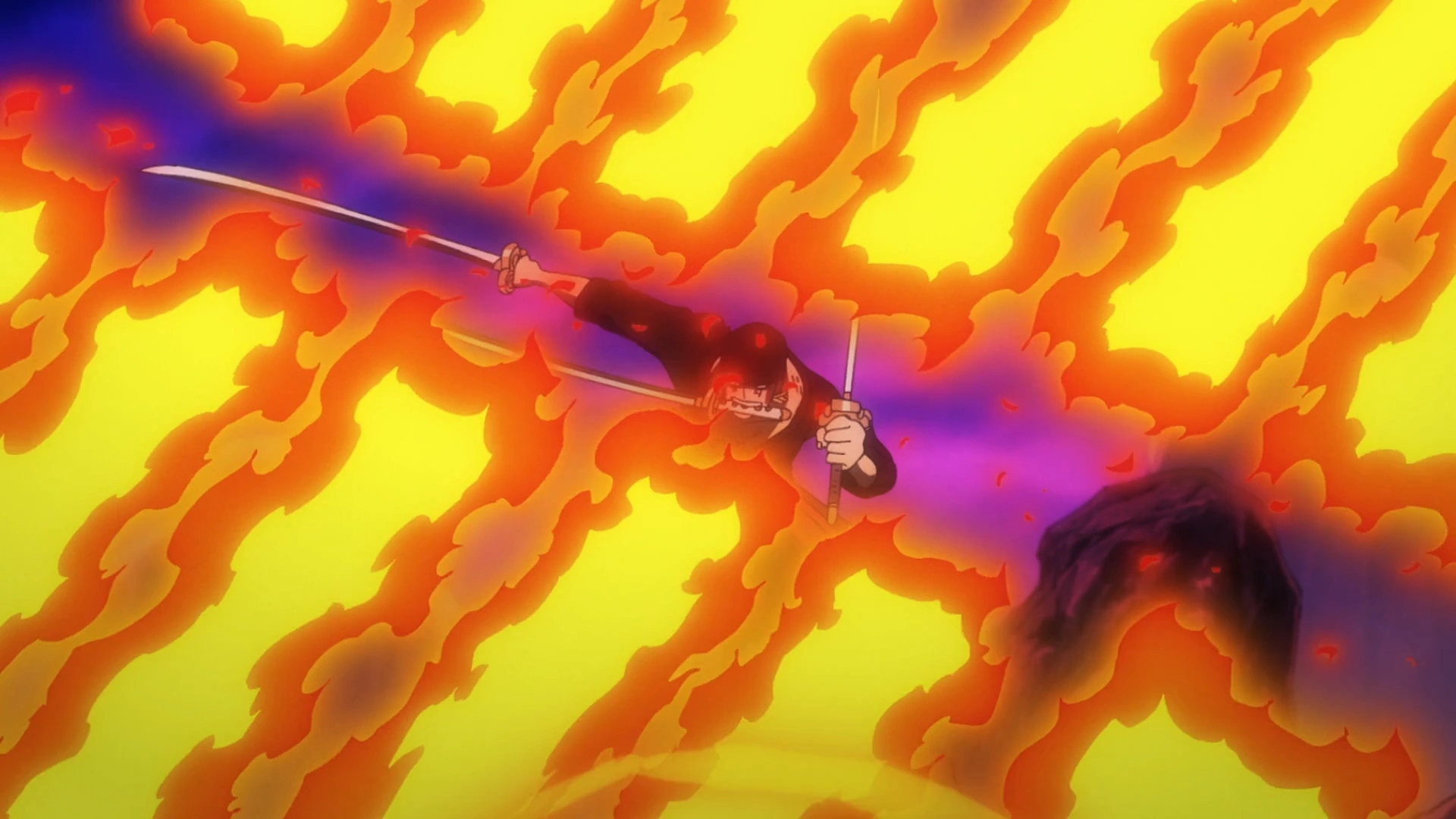
Conqueror’s Haki (Haoshoku): During the Wano arc, Zoro awakened Conqueror’s Haki during his battle with Kaido. Even more impressively, he learned to infuse this Haki into his attacks—a technique only the strongest fighters in the world can use. His “Dead Man’s Game” attack against King demonstrated this devastating ability, producing the distinctive black lightning that indicates Conqueror’s coating.
Enma and Cursed Swords
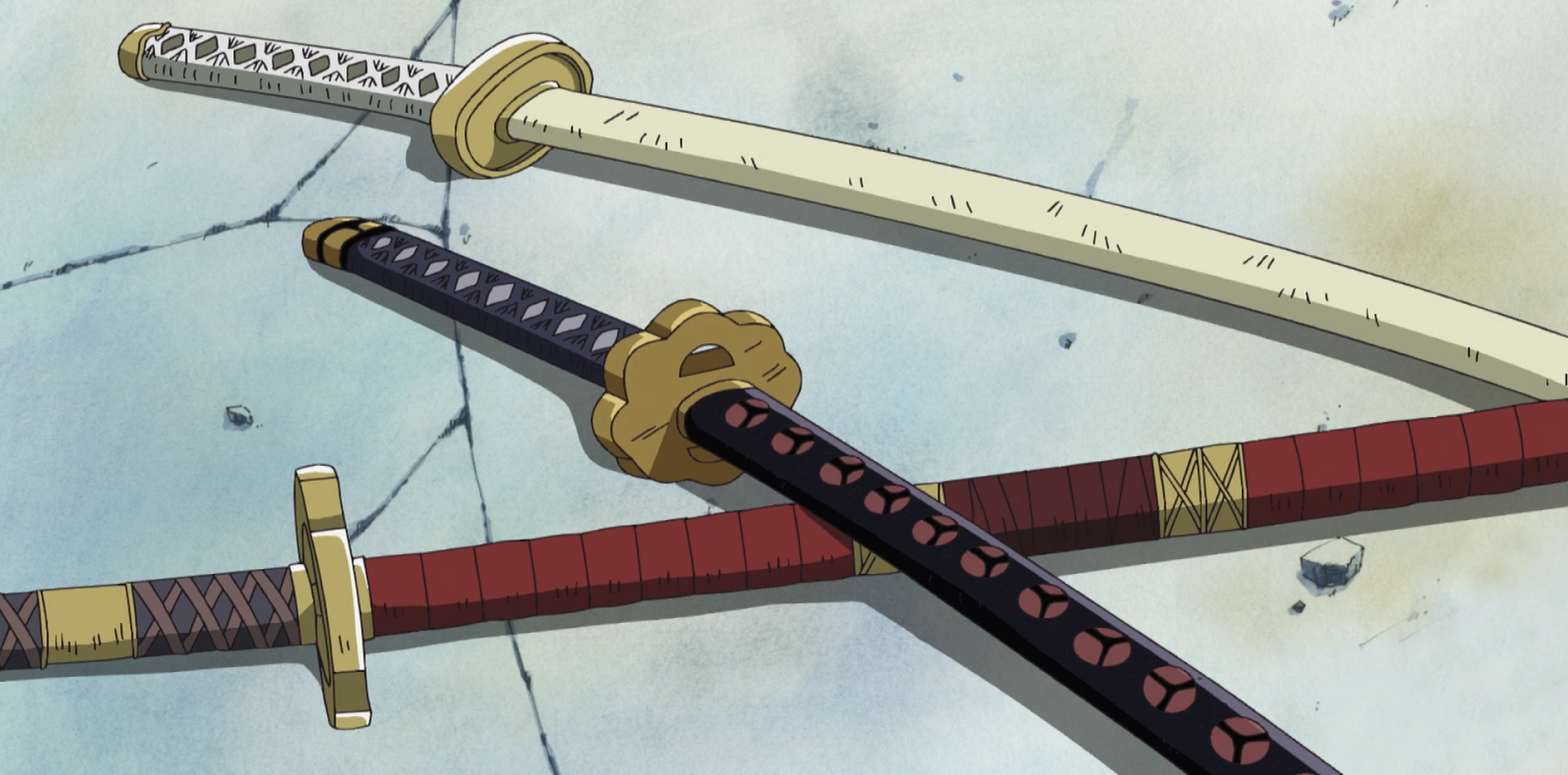
Zoro’s swords are as legendary as he is. His current arsenal includes three of the finest blades in the One Piece world:
Wado Ichimonji: One of the 21 Great Grade Swords, inherited from Kuina. It represents his promise and is his most important blade. Despite being his oldest sword, it remains fully capable of matching newer acquisitions.
Sandai Kitetsu: A cursed Grade Sword that Zoro acquired in Loguetown. Despite its curse supposedly bringing death to all who wield it, Zoro’s luck has proven stronger. The blade seems to respond to his fighting spirit, cutting deeper when he’s determined.
Enma: The legendary blade that belonged to Kozuki Oden, one of only two swords to ever wound Kaido. Enma forcibly drains its wielder’s Haki, making it nearly impossible to control—most would be killed by their own weapon. Zoro’s mastery of Enma proved he possesses Oden-level potential and earned him recognition from the blade itself.
Key Moments
Vs. Dracule Mihawk (Baratie Arc)
Zoro’s first confrontation with his ultimate goal ended in crushing defeat. Mihawk, using only a small knife, completely outclassed him. The gap wasn’t close—Mihawk barely moved while Zoro gave everything. Yet Zoro’s refusal to retreat—taking Mihawk’s slash to the chest rather than his back—earned the World’s Greatest Swordsman’s respect.
“A wound on the back is a swordsman’s shame,” Zoro declared, and Mihawk acknowledged this spirit by using his actual blade for the final strike. This moment defined Zoro’s philosophy: death before dishonor, always facing forward regardless of odds.
“Nothing Happened” (Thriller Bark)
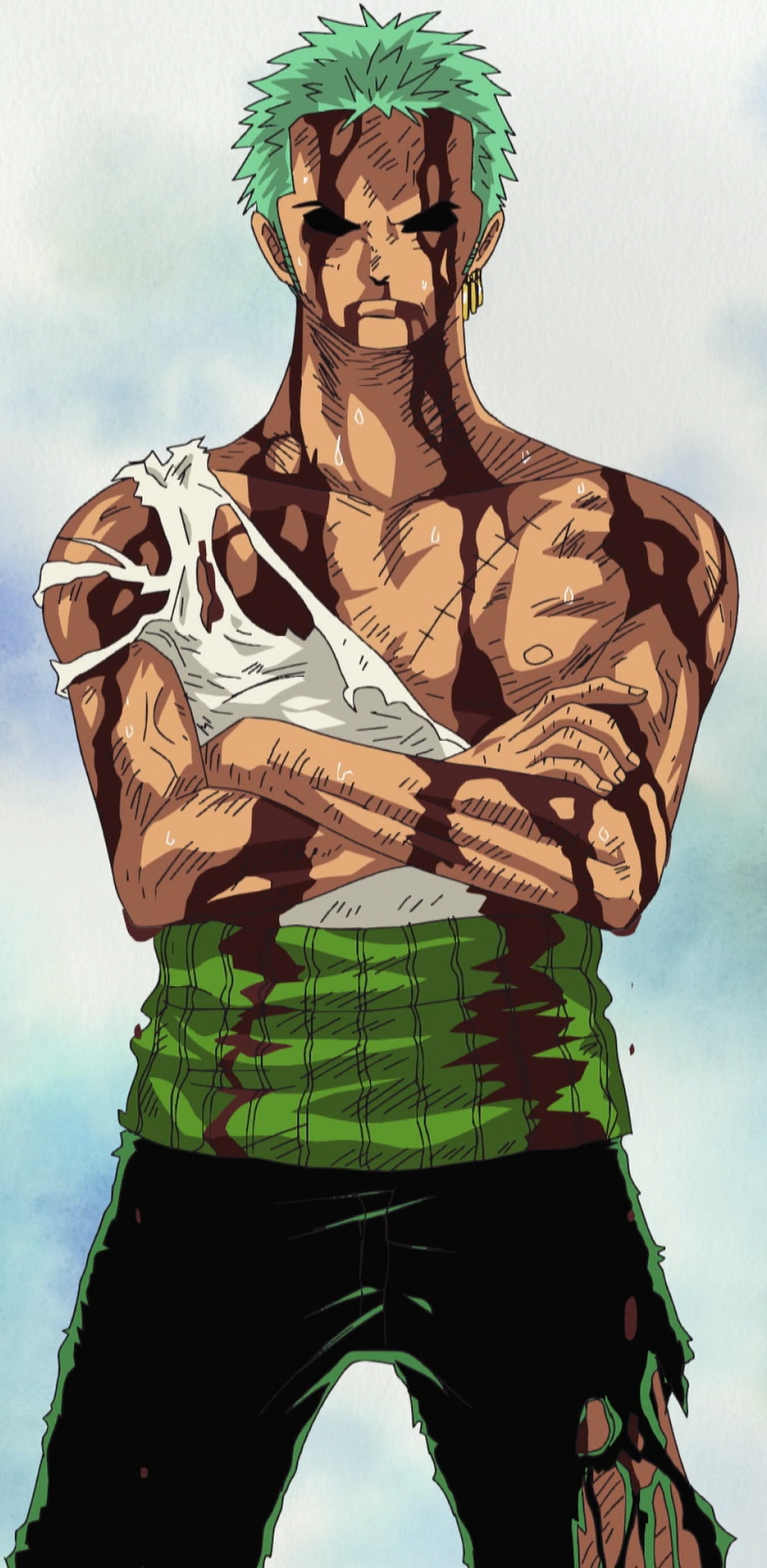
When Bartholomew Kuma threatened to kill Luffy, Zoro offered his own life instead. The Warlord had other ideas—he extracted all of Luffy’s accumulated pain and fatigue, concentrating it into a bubble of pure suffering. He gave Zoro a taste, which nearly killed him. Then Zoro demanded the full amount.
Kuma complied, giving Zoro pain that would kill any normal person ten times over. When Sanji found him standing amidst a pool of blood and asked what happened, Zoro simply replied: “Nothing happened.”
This scene cemented Zoro as the ultimate loyal crewmate and remains one of One Piece’s most powerful moments. His willingness to bear any burden for his captain demonstrated that his strength wasn’t just physical—his spirit was unbreakable.
King of Hell (Wano Arc)
Against King, one of Kaido’s strongest commanders, Zoro pushed beyond every limit. The Lunarian warrior’s durability seemed impossible to overcome—King could toggle between invulnerability and enhanced speed at will. Zoro had to understand his opponent completely while dying from the effects of a magical healing drug.
In this desperate state, he unlocked Conqueror’s Haki coating, fully tamed Enma, and debuted his “King of Hell Three Sword Style.” This battle proved Zoro had reached Yonko Commander level—and possibly beyond. The style’s name acknowledged the demonic themes of his combat, embracing rather than rejecting the dark imagery associated with his techniques.
Scarring Kaido
Zoro became one of only a handful of individuals in history to wound Kaido with his Dead Man’s Game attack. The technique combined all his new abilities—Conqueror’s Haki, Enma’s power, and desperation-fueled determination—into a single strike. While Kaido tanked the attack and continued fighting, he acknowledged that the wound would leave a scar—putting Zoro in the same category as Kozuki Oden himself, the legendary samurai who had wounded Kaido decades ago.
Character Development
Zoro’s growth extends far beyond just power levels. Throughout One Piece, he’s evolved from a solitary warrior into the Straw Hats’ moral compass and vice-captain in all but name.
His loyalty to Luffy is absolute, demonstrated countless times but never more clearly than at Water 7 when he insisted that Usopp apologize properly before rejoining the crew. Zoro understands that a captain’s authority must be respected, even when it’s painful. He was willing to leave his friend behind to preserve the crew’s structure, knowing that allowing Usopp to return without apology would undermine Luffy’s leadership forever.
Post-timeskip Zoro trained under Mihawk himself, transforming from someone Mihawk could defeat with a knife into a warrior who made even the World’s Greatest Swordsman acknowledge his growth. This training wasn’t just physical—Zoro learned to suppress his pride enough to beg his greatest rival for instruction, all for the sake of becoming strong enough to never let his crew down again.
The man who once refused to accept help from anyone humbled himself before his enemy because protecting his captain mattered more than his ego. That growth defines Zoro’s character arc: strength through sacrifice, pride through service.
Technique Ranking: The Complete List
From weakest to strongest, here’s how Zoro’s techniques stack up based on demonstrated power and opponent quality:
Lower Tier:
- Basic slashes and parries
- Oni Giri (original)
- Tora Gari (original)
- Yaki Oni Giri
Mid Tier:
- Ushi Bari
- Gazami Dori
- Hyakuhachi Pound Ho
- Rashomon
- Shishi Sonson (pre-Haki)
High Tier:
- Rengoku Oni Giri
- Sanzen Sekai (Haki-enhanced)
- Shishi Sonson (Haki-infused)
- Purgatory Oni Giri
- Tatsumaki (advanced)
Supreme Tier:
- Asura Ichibugin
- En-o Santoryu techniques
- Dead Man’s Game
- King of Hell: Three Sword Serpent (likely his current strongest)
Legacy & Impact
Roronoa Zoro has become one of anime’s most beloved characters for good reason. He represents unwavering dedication to a goal, loyalty to friends, and the belief that hard work can overcome any obstacle. Unlike many shonen protagonists with special bloodlines or gifted powers, Zoro earned everything through blood, sweat, and steel.
His design, personality, and fighting style have influenced countless manga and anime that followed. The serious swordsman archetype owes much to Zoro’s portrayal, and his techniques have inspired everything from video games to martial arts discussions. His green hair, three swords, and bandana have become iconic symbols recognized even by people who’ve never watched One Piece.
For fans wanting to explore Zoro’s journey, we recommend starting with our One Piece Watch Order Guide to experience his complete story. You can also grab the manga volumes covering his best moments on Amazon.
Zoro’s story isn’t finished yet. With the final saga of One Piece underway, his confrontation with Mihawk looms on the horizon. When that day comes, after decades of following his journey, fans worldwide will hold their breath as Zoro finally reaches for his dream.
The World’s Greatest Swordsman title awaits. And after everything we’ve seen, there’s no doubt—Zoro will claim it.
Related: One Piece Watch Order | One Piece Filler Guide | Strongest One Piece Characters Ranked | Luffy’s Gear 5 Explained
You Might Also Like
- Frieren Power System Explained: Magic, Demons, and Mana
- Frieren Power System Explained: Magic, Demons, and Mana
- Demon Slayer Corps Power Ranking 2026: Every Hashira and Slayer Ranked